DAHN Design Specification v2.10¶
Status¶
Draft replacement for dahn-phase-0-design-spec.md v1.4.
This version re-baselines the DAHN design around the architecture that has emerged through the Space Navigator, Dancer, Visualizer Selection Service, self-describing Active Holon, and dynamic Visualizer work.
It supersedes the Phase-0-specific visualizer selection, canvas, affordance hierarchy, and dynamic-loading models in v1.4 while preserving still-valid MAP/DAHN boundary decisions.
Change Log¶
v2.10¶
- defines discovery evidence as the semantic subject of an Inspector-owned Structure explorer;
- places technical rationale under Technical Details and preserves the captured evidence across presentation switching;
- defines top-level inspection-session ownership, nested disposal, and authoritative discovery-boundary explanations.
v2.9¶
- defines replacement readiness, owner-controlled publication, and contracted state survival;
- makes successful-use capture best-effort, with bounded retries and non-blocking actionable warnings;
- requires report deduplication and preference ordering across occurrences sharing a slot and subject descriptor.
v2.8¶
- defines VisualizerUsage from the space agent's perspective, with implicit agent identity and initial applicability by space, Visualizer, and subject descriptor identity;
- separates reuse across subjects of the same described type from future configuration inheritance across related types;
- defines slot-choice associations, descriptor-specific remembered preference, deterministic usage reuse, neutral overrides, and independent atomic persistence;
- distinguishes successful presentation from preparation and limits low-randomness exploration to Visualizer choice.
v2.7¶
- specifies the implemented descriptor discovery and explicit-choice command contracts, including owner/Theme binding, provenance, assessments, evaluation errors, and materialization limits;
- distinguishes the supported transitional subject interpretations from the broader target subject model.
v2.6¶
- restores adaptation to changing semantics, Visualizers, circumstances, and preferences as foundational design intent;
- distinguishes salience, semantic affinity, learned affinity, explicit choices, and inferred preference evidence;
- defines contextual adaptive-policy inheritance, agent-controlled stability/exploration, and sovereignty constraints;
- separates interaction reporting, successful realization, preference persistence, and collective contribution;
- retains current selection, Theme/MDS, composition, and execution authority.
v2.5¶
- permits slot-compatible Visualizer fallback past an empty TypeKind definer to HolonType;
- declares generic Holon Visualizers applicable only at HolonType;
- preserves nearest eligible selection and explicit ambiguity outcomes.
v2.4¶
- aligns owner-defined slots and agent-relative usage with the Design Concept;
- removes the intervening Property VisualizerKind and selection layer;
- delegates kind semantics to the family specifications;
- consolidates shared allocation, surface/view, state-survival, and selection contracts;
- distinguishes Visualizer Holon identity from executable artifact identity;
- scopes navigation-axis invariants to Path Inspector.
v2.3¶
- makes child selection slot-directed, using the specific slot's
AcceptsVisualizerTypetargets; - bounds nearest-applicable selection at the subject's nearest local TypeKind definer;
- distinguishes PropertyMapSlot/PropertyMapVisualizer from single-property PropertySlot/PropertyVisualizer;
- names the default property-map renderer DefaultPropertyMapVisualizer;
- makes AcceptsVisualizerType definitional.
v2.2¶
- defines
VisualizerKindby the invariant semantic shape of its subject, rather than by geometry, placement, or a current realization strategy; - introduces
Structureas the kind for multiple semantic subjects unified by an organizing topology, distinct from a homogeneous Collection; - treats Rooted Navigation as a generic Structure Visualizer rooted at any Holon, with the current 2D grammar as one realization strategy;
- distinguishes Dancer experience composition from recursive Visualizer composition; and
- clarifies that Slots declare semantic roles and remain orthogonal to spatial realization and recursive allocation.
v2.1¶
- replaces the singular DAHN Selector Function with the DAHN Visualizer Selection Service: a Rust-owned family of typed selectors sharing candidate, compatibility, preference, and explicit-error policy;
- establishes Human Agent Theme selection before Canvas selection;
- establishes Canvas selection as a launch outcome: a Theme-compatible Canvas
Holon is selected from bootstrap-loaded candidates and exposed through a
runtime
CanvasVisualizerwrapper; and - prohibits hard-coded Visualizer fallbacks. A selector returns an explicit no-applicable-candidate error when it cannot make a selection.
v2.0¶
Major architectural re-baseline of the DAHN design specification.
This version supersedes the Phase-0-specific visualizer, selector, canvas, affordance, and dynamic-loading model in v1.4 while preserving the still-valid MAP/DAHN boundary decisions.
Key changes:
- moves final Visualizer selection authority fully into Rust;
- removes the prior split between Rust-side semantic recommendation and TypeScript-side final resolution;
- replaces selector output as a Canvas mount plan with recursive per-request Visualizer selection;
- introduces
VisualizerKindas the DAHN-wide categorization used for discovery, selection, compatibility, stewardship, and eventual Commons organization; - introduces
VisualizerSlotas a Visualizer-local composition contract; - distinguishes Visualizer kinds from local visualizer Slots;
- establishes recursive-but-centralized selection: Visualizers may create child visualization requests, but concrete child implementations are always selected by the DAHN Visualizer Selection Service;
- generalizes selector input beyond
Holonsubjects so Node, Collection, Property, Value, Action, Canvas, and future Visualizer kinds can participate in the same selection architecture; - establishes self-describing Active Holons as the semantic input to Visualizers through effective Properties, Relationships, and Dances;
- removes the preconstructed DAHN-global
AffordanceNode[]presentation model as the primary Active Holon abstraction; - makes descriptor-to-presentation projection the responsibility of the selected Visualizer;
- renames the current Node presentation strategy from
HolonNodeVisualizertoHolonInspectorVisualizer; - defines the six current
HolonInspectorVisualizerSlots:NodeTitleBarSlotActionBarSlotVerticalRailSlotPropertyMapSlotCollectionTabsSlotCollectionViewerSlot
- defines the
HolonInspectorVisualizerprojection grammar:- scalar Properties -> Properties Viewer
ValueArrayProperties -> Collection Tabs- singular Relationships -> Vertical Rail
- plural Relationships -> Collection Tabs
- singular navigational Dances -> Vertical Rail
- plural navigational Dances -> Collection Tabs
- other applicable Dances -> Action Bar
- establishes structural cardinality, rather than runtime result count, as the basis for singular versus plural navigation semantics;
- aligns singular and plural navigation with the Space Navigator Interaction Grammar:
- singular navigation -> horizontal lineage
- plural Holon navigation -> collection-mediated vertical lineage
- introduces Property visualization as a first-class selection boundary;
- establishes
PropertyMapVisualizerselection separately fromValueVisualizerselection; - introduces
ValueViewerSlotas a typical child Slot of a Property Visualizer; - makes
ValueTypea selector input rather than a direct renderer mapping; - introduces Action visualization as a first-class selection boundary;
- allows each projected action/Dance affordance to select an
ActionVisualizer; - formalizes Collection visualization as a first-class Visualizer kind and selector boundary;
- replaces the prior minimal one-region scrolling Canvas model with a Dancer-hosting workspace model and a generic rooted-navigation projection model;
- clarifies the division between:
- Canvas-owned cross-Dancer hosting and external allocation;
- Dancer-owned experience-role composition;
- Visualizer-owned internal semantic topology, composition, and layout;
- establishes that compression, overflow, scanning, maximization, and restore ordinarily preserve selected Visualizer identity rather than trigger reselection;
- preserves parent-owned external allocation and child-owned internal composition;
- incorporates the dynamic Visualizer artifact architecture:
- content-addressed executable identity;
- separation of artifact stewardship from artifact transport;
- Rust-side implementation resolution;
- Rust-side digest/signature verification;
- immutable local caching;
- DAHN-controlled module materialization;
- TypeScript-side instantiation only after authorization;
- removes browser URL/origin as the conceptual identity of a Visualizer implementation;
- aligns Visualizer executable artifacts with the broader MAP executable-artifact model also used for dynamic Dance WASM;
- distinguishes executable provenance from runtime safety;
- introduces the Visualizer Runtime Protocol as both an interoperability contract and a future capability/security boundary;
- preserves Web Components and dynamic import as possible implementation mechanisms without making them the architectural source of Visualizer identity or authority;
- preserves the public MAP SDK as the sole TypeScript-facing MAP boundary;
- preserves Rust as the authoritative holder of Holon/model semantic state;
- preserves reference-centered TypeScript access and avoids establishing a second authoritative TypeScript Holon model;
- preserves Rust-side effective descriptor flattening rather than TypeScript-side inheritance reconstruction;
- adds explicit architectural invariants covering Selector authority, Slots, recursive composition, navigation shape, artifact identity, verification, and bootstrap-selection behavior;
- treats deterministic bootstrap selection as ordinary policy rather than permanent one-Visualizer-per-kind mappings;
- adds explicit near-term design priorities for Selector requests, Slots, Dance semantics, Property/Value/Action visualization, dynamic artifact loading, and the Visualizer Runtime Protocol.
v1.4¶
- aligned Phase 0 with the TypeScript MAP SDK implementation spec v1.3;
- recorded
BoundHolonCollectionas an abandoned design branch and removed it from the DAHN-facing target posture; - treated public plural holon-backed traversal and relationship results as
HolonCollection; - treated query/navigation-like DAHN behavior as descriptor-afforded Dances invoked through the public SDK rather than through a command-owned query envelope;
- treated new-world Dance results as response-holon handles rather than standalone
DanceOutcomeobjects; - clarified that DAHN or other above-SDK caller layers own
RequestOptionsdecisions such assnapshot_after,gesture_id, andgesture_label.
v1.3¶
- captured an intermediate bound-first Dance/query contract posture;
- superseded by v1.4 for current
HolonCollection, Dance-response, and query/navigation guidance.
1. Purpose¶
DAHN is the experiential layer through which people inspect, navigate, act upon, and eventually edit the self-describing active holons of the MAP.
This specification defines the DAHN runtime architecture required to support:
- self-describing Active Holons;
- Visualizers as open-ended, dynamically selectable presentation implementations;
- recursive Visualizer composition through Slots;
- Dancer composition of experience roles;
- centralized visualizer selection through the DAHN Visualizer Selection Service;
- descriptor-driven projection of Properties, Relationships, and Dances;
- Space Navigator topology and allocation semantics;
- dynamic loading of Visualizer implementation artifacts;
- the public MAP SDK as the sole TypeScript-facing MAP boundary;
- Rust as the authoritative holder of MAP semantic state and DAHN selection state.
The specification intentionally separates:
- semantic description from presentation;
- Visualizer composition from Visualizer selection;
- Visualizer selection from implementation loading;
- navigation topology from Visualizer layout;
- Dancer experience composition from visualizer composition;
- executable artifact identity from artifact transport;
- artifact provenance from runtime authority.
2. Relationship to Adjacent Specifications¶
DAHN Architecture assigns subsystem responsibility and the MAP/Rust versus TypeScript state boundary. This specification defines reusable composition and runtime mechanisms through which those responsibilities are realized. Kind specifications define semantic subject families; owner-defined slot contracts supply local participation requirements.
The Space Navigator grammar defines Dancer-level composition and interactions. The Path Inspector grammar owns that Visualizer's topology, lineage, grid, focus, and compression productions. Concrete Node and Collection behavior belongs to its selected Visualizer.
Examples of a recursive hierarchy are illustrative, not a required composition. Implementation plans sequence the design and do not create another authority.
3. Core Architectural Principles¶
DAHN is Dynamic, Adaptive, and Holon-aware. Dynamic composition defers presentation decisions to runtime; adaptation lets those decisions respond to changing circumstances and accumulated experience. Neither requires a closed set of Holon types or Visualizers, or a centralized redesign of the human interface whenever the MAP evolves. Adaptation serves the Human Agent's aims and preserves their ability to shape, stabilize, and explore the experience.
3.1 MAP semantics remain authoritative¶
DAHN does not create a second semantic model of MAP data.
Authoritative Holon state, descriptors, relationships, Dances, transaction state, and other MAP semantics remain in Rust/MAP runtime layers.
TypeScript operates primarily through reference-backed public SDK objects and small derived presentation state.
3.2 Holons describe affordances, not UI¶
An Active Holon exposes what it is and what it affords through effective descriptors.
At minimum, DAHN must be able to discover:
PropertyMap
Relationships
Dances
Those semantic affordances do not prescribe how they are rendered.
The selected Visualizer determines how those affordances are projected into presentation.
3.3 Visualizers define presentation grammar¶
A Visualizer defines:
- its internal layout;
- its Slots;
- how semantic affordances populate those Slots;
- what child visualization requests it creates;
- how it realizes itself within the allocation assigned by its parent.
Different Visualizers may project the same Active Holon differently.
3.4 Visualizer selection is centralized¶
Concrete Visualizer implementations are selected exclusively through the DAHN Visualizer Selection Service.
A Visualizer may request another Visualizer for one of its Slots, but it must not directly choose that child implementation.
Therefore:
Selection is recursive and compositional, but centralized.
3.5 Visualizer composition and selection are separate¶
A composition owner determines:
This role binds this subject and requires this contract.
The Visualizer Selection Service determines:
Which available, applicable Visualizer fulfills this slot contract?
A Slot expresses the first question.
The Visualizer Selection Service answers the second.
3.6 Navigation topology and Visualizer composition are separate¶
Canvas owns external allocation to a hosted Dancer experience. The Dancer composes its experience roles, and its selected Rooted Navigation Visualizer owns the interaction-derived navigation occurrence topology and its internal realization within that allocation.
Compression, overflow, scanning, maximization, and other projection changes do not ordinarily cause Visualizer reselection.
4. Design Concept¶
DAHN realizes experiences through recursive, contract-based composition rather than through a centrally prescribed presentation hierarchy.
DAHN specifies the grammar of composition. Visualizers specify the grammar of experience.
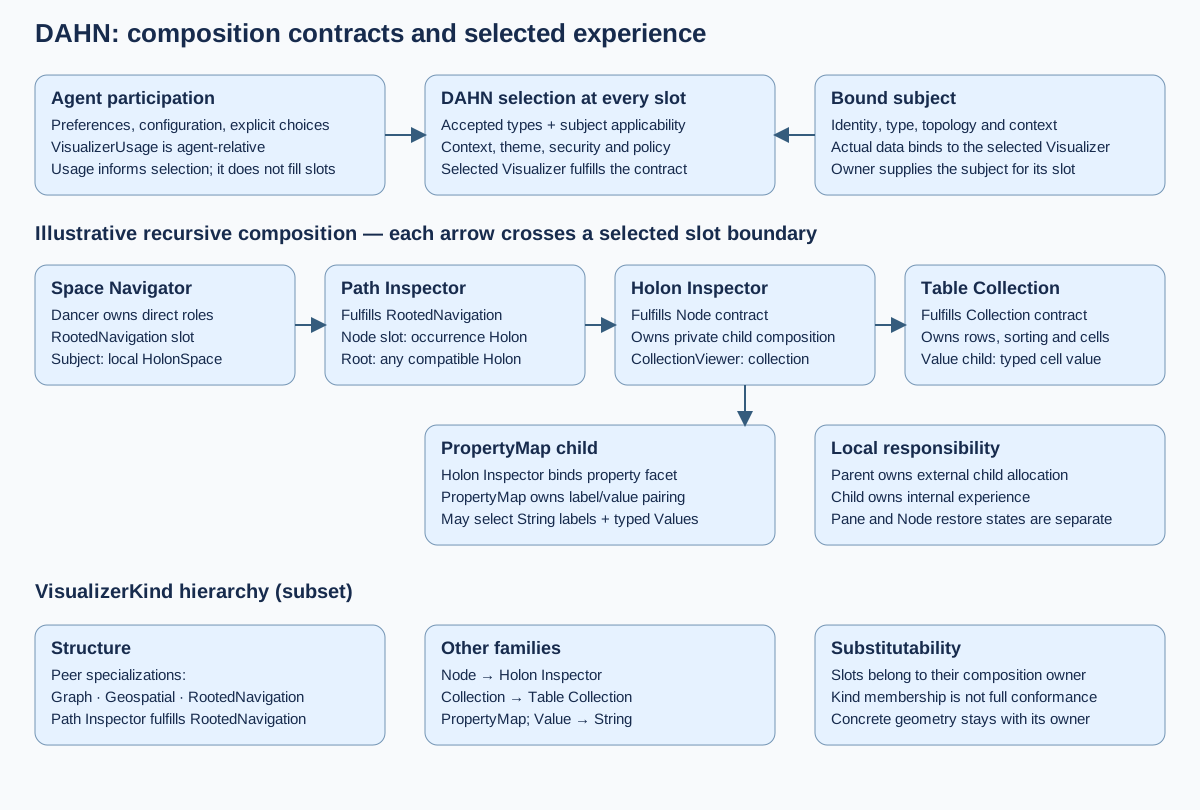
This diagram is illustrative. Every slot is resolved through DAHN selection; subject applicability, accepted types, context and policy jointly constrain that selection. VisualizerUsage records agent-relative use/configuration, not slot fulfillment or a running occurrence’s state. Exact holonic participation and presentation-action representation remain open.
4.1 Experience Composition and Data Coupling¶
Dancers compose experiences. They determine which roles an experience requires and couple those roles to the MAP subjects on which the experience operates.
For example, the Space Navigator Dancer establishes a rooted-navigation role
whose subject is the local HolonSpace. The selected Visualizer need not know
that it is participating in Space Navigator. It receives the subject and
context required by the slot it fulfills.
This distinction permits the same Visualizer to participate in many experiences
over different subjects. A Path Inspector, for example, may realize rooted
navigation over any compatible Holon; Space Navigator is responsible for
binding its rooted-navigation role specifically to the local HolonSpace.
4.2 VisualizerSlots as Composition Boundaries¶
A VisualizerSlot is a point of substitutability in the compositional
hierarchy.
A slot:
- identifies the visual role to be fulfilled;
- specifies the contract a Visualizer must fulfill;
- binds the subject or subjects to be visualized;
- carries applicable context, constraints, and configuration inputs; and
- establishes an interaction point with a DAHN Selector Function.
The owner of a slot is authoritative over the requirements at that boundary, but not over the internal experiential grammar of the Visualizer selected to fulfill it.
Dancers may define VisualizerSlots for visual roles within an experience. Visualizers may recursively define child VisualizerSlots required to realize their own experiential grammar.
Consequently, composition is recursive:
Dancer
    -> VisualizerSlot
        -> selected Visualizer
            -> VisualizerSlot
                -> selected Visualizer
                    -> ...
Every slot is independently substitutable.
Deriving a custom Visualizer by composition¶
When deriving a custom Visualizer from an existing Visualizer, consider each of its child slots in turn. Ask whether the custom presentation requires different behavior at that slot, or whether the existing behavior already satisfies its purpose. Where existing behavior is sufficient, reuse the same implementation through composition; do not duplicate it in the specialized parent. Customize only the slots whose behavior must differ.
This review preserves owner-local slot contracts and normal selection authority. Reusing an implementation does not share occurrence identity, allocation state, or subject bindings between parents, and it does not bypass slot compatibility or selection. Each parent retains its own composed child occurrence.
Apply the same reuse discipline to implementation-owned regions that do not occupy independent Visualizer slots. Such regions may use shared implementation components without inventing semantic slot bindings. For example, ordinary Holon Inspector and Load Holons Inspector share Title Bar behavior while their bodies retain the specialization each requires.
4.3 Contracts and Visualizer Fulfillment¶
Conceptually:
Visualizer
    |
    | defines child
    v
VisualizerSlot
    |
    | specifies
    v
VisualizerSlot Contract
    ^
    | fulfills
    |
Visualizer
    ^
    | used through
    |
VisualizerUsage
    ^
    | belongs to
    |
Agent
A Visualizer fulfills a VisualizerSlot contract. VisualizerUsage does not
fulfill the slot; it captures an agent's use and configuration of a Visualizer
that does.
A Visualizer can therefore simultaneously:
- fulfill the contract of the parent slot into which it was selected; and
- define child slots through which it recursively composes its own experience.
This recursive contract boundary distributes design authority throughout the composition rather than concentrating it in DAHN or in a top-level Dancer.
4.4 Subjects and MAP Data¶
Visualizer selection is not independent of data.
A slot binds a semantic subject drawn from MAP. The subject's identity, type, descriptor-derived affordances, and relevant topology form part of the selection context. The selected Visualizer is subsequently bound to the actual subject data it realizes.
The distinction between subject type and subject data is important:
- subject type and topology help determine which Visualizers are applicable;
- the subject itself supplies the MAP data the selected Visualizer realizes.
For Space Navigator, the top-level subject is the local HolonSpace. A
RootedNavigation Visualizer such as Path Inspector may be capable of operating
over many Holon types; Space Navigator supplies the particular root subject
that makes this instance a Space-navigation experience.
4.5 Selector Functions¶
Every VisualizerSlot establishes a selection boundary.
A DAHN Selector Function resolves that boundary by selecting an available Visualizer that fulfills the slot contract and is applicable to the bound subject and current context.
Selection may consider, among other inputs:
- the required VisualizerSlot contract;
- subject identity, type, and topology;
- available Visualizers and their declared applicability;
- agent preferences;
- prior VisualizerUsage;
- environment and form factor;
- theme and Meta-Design-System compatibility;
- security and execution constraints.
The Selector determines which Visualizer fulfills the role. The selected Visualizer determines how the experience is realized behind that boundary.
4.6 Agent Agency and Personalization¶
Agents are active participants in DAHN composition rather than passive recipients of Selector decisions.
An agent may:
- establish preferences that influence selection;
- configure a selected Visualizer through its
VisualizerUsage; - override a Selector choice and choose another conforming Visualizer;
- save configurations or presets; and
- provide usage history from which subsequent preferences may be derived.
VisualizerUsage records this agent-relative relationship with a Visualizer,
including selection, configuration, state, and outcomes as appropriate.
Prior usage may influence subsequent selection both for the individual agent and, subject to applicable governance and privacy constraints, through aggregate preferences derived across agents.
4.7 Recursive Composition and Distributed Design Authority¶
The selected Visualizer owns the experiential grammar behind the slot contract.
If that Visualizer requires additional visual roles, it defines child VisualizerSlots. Each child slot becomes another point of substitutability and another interaction point with DAHN selection.
For example:
Space Navigator Dancer
    -> RootedNavigation VisualizerSlot
        subject = local HolonSpace
        -> Path Inspector
            -> Node VisualizerSlot
                subject = selected Holon
                -> Holon Node Visualizer
                    -> Collection VisualizerSlot
                        subject = related Holons
                        -> Collection Visualizer
The example is illustrative, not prescriptive. Space Navigator does not own Path Inspector's internal composition, Path Inspector does not own the selected Node Visualizer's internal composition, and DAHN does not prescribe any of their experiential grammars.
This yields the central authority rule:
A composition owner specifies the contract, subject, and constraints at its slot boundary. The selected Visualizer owns the experiential realization behind that boundary.
4.8 Adaptive Human Experience¶
Dimensions and evolving context¶
DAHN supports adaptation to device form factor, language and cultural conventions, Themes and presentation conventions, evolving Holon types, evolving Visualizers, individual preferences, and collective experience. These dimensions interact: subject semantics, slot obligations, runtime and security constraints, and the selected Theme's effective MDS establish eligibility before preferences arbitrate among eligible alternatives.
Responsive layout remains the selected Visualizer's responsibility within parent-owned allocation. Available space may affect prominence and disclosure; it does not ordinarily trigger semantic Visualizer reselection. Locale and timezone may be inherited presentation context with explicit local overrides. Theme selection remains Human Agent and HolonSpace driven; adaptive affinity must not silently select a different Theme or let Canvas choose the effective MDS independently of that selection.
Salience and affinity¶
Salience expresses contextual relative importance. It may inform property, relationship, action, and column prominence, ordering, disclosure, and information density. A constrained region may show fewer low-salience elements while retaining access to them. Presentation salience neither authorizes an Action nor establishes the existence or availability of semantic information.
Affinity expresses association or preference. Semantic affinity identifies meaningful associations, such as address fields or related actions belonging together; learned preference affinity reflects an agent's or community's experience of alternatives. Affinity groups and comparative affinity signals are distinct concepts. Observed co-navigation or embedding may be evidence of association, but does not author a semantic relationship or modify descriptor structure. No numeric score representation or learning algorithm is prescribed.
Concrete Visualizers define the relevant grouping and personalization interactions. Examples include Node property visibility/order, Action prominence and grouping, Value representation, Collection layout/column preferences, and Structure node placement or relationship disclosure. These examples do not restore a Property or Graph kind, prescribe a universal drag handle, or override kind-specific contracts. Filtering changes what information is requested or included; sorting, arranging, and choosing a representation change its presentation. Their execution and mutation authorities remain distinct.
Personal and collective feedback¶
Personal adaptation reuses appropriately scoped configuration and preference evidence across encounters with similar subjects. Preferences are contextual, not a globally fixed descriptor-to-Visualizer mapping. Agent, space, subject semantics, slot contract, task, interaction mode, and environment may matter; which factors define reusable preference identity remains an explicit design question.
Explicit durable preferences, pinned choices, temporary occurrence choices, inferred behavioral patterns, and incidental interactions MUST remain distinguishable. Remembering a prior selection provides personal affinity evidence; it does not automatically pin every future selection. The agent's adaptive policy determines the influence of that evidence relative to evolving collective evidence and discovery. A pin protects an eligible choice within its declared scope; it cannot waive compatibility or execution policy. A newly available alternative or a changing learned score MUST NOT silently displace an explicit protected choice. If that choice becomes ineligible, report the reason and follow the applicable explicit reselection contract rather than forcing it to execute.
Collective adaptation is an intended feedback loop: ordinary personalization and navigation interactions produce applicable evidence that is automatically accumulated and aggregated under the agent's established contribution settings and Agent Space governance. It should not require a separate survey or manual submission of every gesture. Collective signals improve defaults, particularly where personal experience is absent, while remaining advisory and subject to individual control.
Aggregation supports both community-specific populations and broader, potentially MAP-wide populations across participating Agent Spaces. Global reach does not require one centralized store of raw behavioral data. Different communities can maintain distinct defaults while contributing to or consulting broader aggregates under their chosen governance.
The agent controls personal preference information. Personalization MUST NOT require collective contribution; consent and disclosure may be established at the relevant participation/settings scope rather than requested for every gesture. Automatic capture, permitted contribution, and aggregation then follow that policy. Population boundaries, storage, retention, withdrawal, and the federated aggregation protocol remain to be designed.
Stability and discovery¶
The Human Agent can favor predictable reuse or discovery of eligible alternatives. Explore/exploit is a continuum, not a compulsory pair of modes. Adaptive controls affect choice after viability has been established; they do not lower subject, slot, Theme/MDS, runtime, authorization, or execution requirements. Release maturity is a preference unless an independently stated execution/governance requirement makes it a hard constraint. Agent-facing adaptive controls are part of the intended experience. The historical four-slider model makes four complementary dimensions tangible:
- Personal versus collective weighting: controls the relative influence of personal and aggregate salience/affinity evidence. At the pinned personal extreme, applicable personal preferences take precedence while viable. Moving toward collective weighting allows later policy decisions to depart from a previous personal selection; remembering that selection does not freeze it.
- Trending: applies to aggregate evidence, shifting emphasis from all-time popularity toward shorter-term emerging preferences. It gives new Visualizers opportunities without erasing personal preference history.
- Maturity: expresses preference for established releases versus newer releases such as beta or alpha, within the viable candidate population.
- Randomness: varies policy-governed choice among viable alternatives and may select a less preferred maturity or affinity option. It cannot bypass the viability floor or an applicable pin.
Sliders are an illustrative interface for these continua, not a commitment to fixed numeric ranges or exactly four widgets. The ability for agents to control these dimensions is enduring design intent; precise controls, time windows, maturity representation, and scoring/exploration algorithms remain open. Maturity preference is distinct from hard runtime/trust eligibility. Exploration cannot relax eligibility or an explicit protected choice. Deterministic bootstrap selection does not require these controls to be implemented immediately.
Accepting a default does not by itself establish a durable explicit preference. Whether passive acceptance contributes weaker learning evidence remains open; its treatment must address exposure bias and feedback loops that suppress new alternatives. Discovery of alternatives and adoption of a new presentation are separate acts. An applicable pin stabilizes automatic choice; it does not remove new viable alternatives from discovery or prevent the person from inspecting collective trends and deliberately changing their choice. Permission to apply adaptive policy at a later selection point does not itself authorize replacing an already mounted occurrence; replacement retains its lifecycle contract.
Default Randomness Policy¶
Absent an explicit adaptive-control setting, automatic Visualizer choice defaults to low, nonzero randomness. The space agent's applicable prior preference is favored for the vast majority of selections; occasional exploration may choose another eligible Visualizer. This default does not require a slider UI. Randomness applies to Visualizer choice only, not selection among usage configurations. Eligibility and execution constraints still apply to every alternative, and an explicit current choice is not overridden by exploration. The exploration rate and the evidence that establishes prior preference remain to be specified. Selecting an alternative does not itself authorize replacement of an already mounted occurrence.
An exploratory Visualizer choice leaves the space agent's remembered preference unchanged. The alternative may have an existing or newly initialized usage, but the system's random choice is not evidence of the agent's preference. An explicit agent choice of that alternative can establish remembered preference; exploration alone must not overwrite it.
Inherited adaptive policy¶
An agent may establish an experience-wide adaptive policy in the Canvas context and override its applicable dimensions within a Dancer experience or a selected Visualizer's descendant composition. Contextual inheritance follows explicit composition/request boundaries, not DOM ancestry or a persistent usage tree. Canvas hosts that context; Rust resolves its adaptive meaning through the Visualizer Selection Service. Descendants do not gain independent selectors.
Mandatory eligibility and execution constraints always apply. Within the scope of an eligible explicit choice or pin, inherited or learned policy cannot silently override it. Applicable local policy overrides inherited policy; the resulting policy controls the influence of personal and collective signals and defaults. A direct choice governs the requested selection, not all later encounters. Persistent protection comes from applicable pinned policy; ordinary remembered or learned preference can give collective or exploratory signals more influence when the agent requests it. There is no universal fixed ordering of learned personal and collective scores.
The exact override granularity, policy representation, persistence scope, and conflict handling remain open. Inheritance does not mutate shared Visualizer definitions, overwrite an existing VisualizerUsage configuration, or turn an occurrence-local choice into a session-wide or durable preference.
Authority and related work¶
The Rust-owned selection authority evaluates eligibility and adaptive selection policy. Dynamic Experience Composition binds subjects, supplies inherited context, negotiates allocation, and owns presentation lifecycle. Selected Visualizers render, expose useful personalization gestures, and report their semantic interaction meaning. Rust services interpret preference evidence and manage persistence and governed aggregation through the public SDK boundary.
Interaction reporting defines the shared boundary. VisualizerUsage defines agent-relative configuration, separate from running occurrences. The adaptive usage capture exploration collects possible metrics and record shapes; it does not establish another selection authority or a finalized persistence schema.
These principles preserve the intent of the 2022 DAHN design and Visualizer examples. Current typed selectors, owner-defined slots, Theme-first selection, and semantic/artifact/usage/occurrence identity boundaries supersede historical mechanisms. The examples are design history, not mandated current UI structures.
5. Public MAP SDK Boundary¶
DAHN consumes MAP exclusively through the public TypeScript MAP SDK.
DAHN must not depend on:
- command-wire types;
- IPC envelopes;
- internal request metadata;
- private SDK command builders;
- transport implementation details;
- transitional bridge payloads;
- legacy query envelopes.
DAHN may consume public:
MapClient;MapTransaction;HolonReference;HolonCollection;- descriptor handles;
- Dance invocation handles;
- Dance response handles;
- public request-option surfaces.
The public SDK remains the semantic boundary between DAHN TypeScript and MAP runtime functionality.
6. State Ownership¶
6.1 Rust-owned state¶
The architecture state boundary owns the semantic/experiential distinction. Rust is authoritative for MAP state, selection, implementation resolution, and artifact verification. TypeScript consumes reference-backed semantics through the public SDK.
6.2 TypeScript-owned state¶
Experience state includes occurrence identity, selected tabs/rows, expansion, layout, focus/hover, viewport, temporary render projections, DOM, and animation state. It is not an independent MAP object graph. The shared state-survival contract separates visual operations from semantic disposal.
7. Active Holon Model¶
For DAHN purposes, an Active Holon is a Holon together with its effective semantic affordances.
Conceptually:
ActiveHolon
    identity
    effective descriptor
        PropertyMap
        Relationships
        Dances
The effective descriptor must already reflect the MAP descriptor semantics required for DAHN consumption.
TypeScript must not reconstruct descriptor inheritance independently.
8. Descriptor Requirements for DAHN¶
DAHN depends upon sufficiently expressive effective descriptors.
8.1 Property Descriptor¶
A Property Descriptor must provide enough information to determine at minimum:
- Property identity;
- Property label/description where available;
- associated ValueType;
- structural value semantics;
- constraints required for presentation;
- whether its value is scalar or collection-shaped.
8.2 Relationship Descriptor¶
A Relationship Descriptor must provide enough information to determine:
- relationship identity;
- target Holon Type;
- minimum cardinality;
- maximum cardinality;
- declared versus inverse relationship semantics;
- other presentation-relevant relationship metadata.
Structural cardinality is semantic input; it does not prescribe a navigation axis.
Runtime result count must not change whether the affordance is treated as singular or plural.
8.3 Dance Descriptor¶
A Dance Descriptor must expose sufficient declarative semantics for a Visualizer to classify the Dance without:
- inspecting its implementation;
- relying on naming conventions;
- hard-coding knowledge of individual Dances.
At minimum, DAHN requires information sufficient to distinguish:
- navigational behavior;
- non-navigational actions such as commands and mutators.
It must also expose the structural shape of the Dance response.
Relevant dimensions may eventually include concepts such as:
interaction intent
    navigation
    command
    edit
    create
    delete
    invoke
    ...

effect semantics
    read-only
    mutating
    ...

response shape
    none
    scalar
    0..1 Holon
    1 Holon
    0..* Holon
    1..* Holon
    structured result
    ...
These dimensions should remain declarative and should not dictate presentation.
9. Visualizer Model¶
9.1 AbstractVisualizer¶
AbstractVisualizer is the common semantic base for DAHN Visualizers.
A Visualizer is a first-class MAP Holon representing a semantic visualization capability. Its executable implementation is a separate realization. See semantic identity.
An Abstract Visualizer may define zero or more Slots.
Conceptually:
AbstractVisualizer
    Slots -> VisualizerSlot [0..*]
Visualizers are ultimately intended to be MAP-stewarded holons rather than permanently hard-coded application metadata.
10. VisualizerKind¶
VisualizerKind is a DAHN-wide classification.
It identifies the invariant semantic shape of the subject a Visualizer knows how to realize. It is not defined by a visual arrangement, placement, current geometry, or layout strategy.
The defining test is:
What can a Visualizer of this kind assume about its subject without knowing the application-specific domain?
Initial kinds include:
Canvas
Node
Collection
Structure
PropertyMap
Value
Action
Additional kinds may emerge as DAHN evolves.
The current kinds carry these core assumptions:
| Kind | Subject invariant |
|---|---|
| Canvas | A visual workspace/composition that owns top-level spatial resources. |
| Node | Exactly one Holon. |
| Collection | Multiple Holons or values sharing an effective element shape. |
| Structure | Multiple semantic subjects unified by an organizing semantic topology. |
| PropertyMap | The property facet exposed by one Holon's effective descriptor. |
| Value | Exactly one value governed by one value-type contract. |
| Action | One executable affordance together with required input and context. |
Structure is not an arbitrary heterogeneous bag of Holons. Its topology is
the semantic invariant that makes the multiple subjects one visual subject.
Graph, Rooted Navigation, and Geospatial visualizers are candidate Structure
specializations because each understands a different organizing topology.
VisualizerKind is expected eventually to participate in:
- Visualizer discovery;
- Visualizer Commons;
- stewardship;
- candidate filtering;
- compatibility constraints;
- Visualizer Selection Service policy.
VisualizerKind must not be confused with the internal Slots of a particular Visualizer.
For example:
PropertyMapSlot
is not automatically a DAHN-wide VisualizerKind.
10.1 Kind authority and slot authority¶
The family index links the authoritative kind contracts. Structure, RootedNavigation, Node, Collection, PropertyMap, and Value define subject semantics independently of particular layouts. String specializes Value. Graph and Geospatial are Structure specializations alongside RootedNavigation, not its parents.
A slot can constrain accepted Visualizer types and additional participation requirements. Kind membership alone does not establish conformance to that slot. PropertyDescriptor metadata remains meaningful, but Property is not a separate VisualizerKind. New kind directories are created on demand only.
11. VisualizerSlot¶
A VisualizerSlot is a local composition and substitutability boundary defined
by a Dancer or Visualizer. It declares a semantic role, required contract,
subject binding, applicable context, and participation constraints. It is not
merely a region, layout coordinate, or a kind name.
The slot owner supplies the requirements at that boundary. The selected Visualizer fulfills them and owns its internal realization, including any child slots. The owner must not reach through the boundary to prescribe those internals.
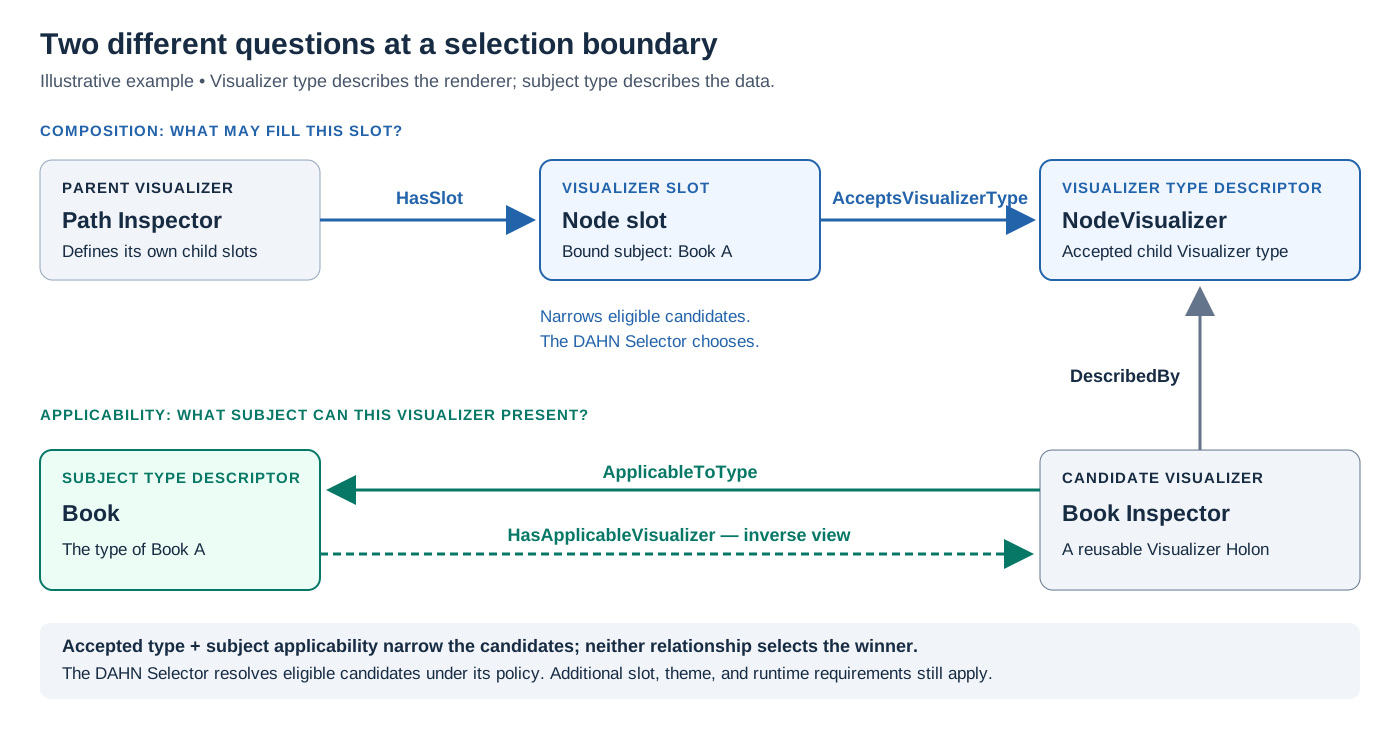
The diagram uses an exact type match for clarity; selection also considers accepted subtypes under the slot-directed policy. The two green arrows show the same applicability relationship in opposite directions.
These relationships answer different questions:
Visualizer —HasSlot→ VisualizerSlot: “What child slots does this Visualizer define?” A Visualizer uses this relationship to declare the sub-slots through which it composes its experience. It does not choose the concrete Visualizers that will fill them.VisualizerSlot —AcceptsVisualizerType→ Visualizer type descriptor: “What types of Visualizer may fill this slot?” The target describes the child Visualizer, not the data being visualized. For example, a Node slot may accept Visualizers described byNodeVisualizeror an accepted subtype. This relationship is definitional: the accepted types are part of what the slot requires, rather than a preference for a particular implementation. It narrows the candidates the DAHN Selector may choose from; it does not name the winner or select a concrete Visualizer. Multiple Visualizers can have accepted types and remain eligible for the same slot.Visualizer —ApplicableToType→ TypeDescriptor: “What types of subject can this Visualizer present?” The target describes the data subject. For example, a specialized Book Inspector might declare applicability to theBooktype. This says nothing about which parent defines a slot or where that Visualizer will appear.TypeDescriptor —HasApplicableVisualizer→ Visualizer: “Which Visualizers declare applicability to this subject type?” This is the inverse view ofApplicableToType, not a separate compatibility rule. From theBookdescriptor, it lets selection discover applicable candidates such as the Book Inspector.
The DAHN Selector brings these requirements together. AcceptsVisualizerType
filters candidates by their Visualizer type; subject applicability further
limits which candidates can present the bound subject. Neither relationship
chooses the winner. The Selector resolves the remaining candidates under its
selection policy, including applicable preferences and explicit agent choice.
If none qualifies, selection returns an explicit error; if several qualify and
no ranking or choice policy resolves them, it reports ambiguity rather than
choosing arbitrarily.
A candidate must therefore have a Visualizer type accepted by the slot and be applicable to the bound subject under the selection policy. A Book Inspector could be applicable to a Book but still be unsuitable for a slot that requires a Collection Visualizer. Conversely, a Visualizer could have an accepted Node type but be applicable only to a subject type other than Book. Other slot, theme, runtime, and policy requirements still apply; these relationships alone do not guarantee selection.
Dancer-owned slots have the same conceptual authority; their exact schema representation must preserve that ownership rather than inventing an implicit parent Visualizer.
Every actual slot identifies its owner, accepted role/contract, bound subject, and context. A selector request carries that specific slot; the selector does not infer it by searching a parent's roles after choosing an implementation. Shared participation and allocation mechanisms are defined in Parent-Owned Allocation.
11.1 VisualizerUsage¶
VisualizerUsage represents the use of a Visualizer by the space's agent. It
records the fact that this agent has used the Visualizer and provides an anchor
for personalized choices concerning that use, including configuration, state,
selection history, and outcomes as applicable.
Usage decisions are made from the perspective of the space's agent. Agent identity is implicit in that perspective, not a caller-supplied usage-selection parameter. A space does not manage a collection of usages for independently selected agents. The selected Visualizer fulfills the slot contract; usage does not fulfill it.
Usage belongs in the agent's applicable context, such as an I-Space or We-Space, so configuration and history do not mutate the shared Visualizer stewarded by its provider or Commons. Usage identifies the selected Visualizer and subject descriptor, anchors personalized configuration, and records association with the slot choice-point at which that Visualizer was selected. It does not own the slot or the Visualizer's private layout.
Conceptually:
owner -> defines slot -> specifies contract and binds subject
selected Visualizer -> fulfills contract
agent -> VisualizerUsage -> uses/configures selected Visualizer
Persistent usage, runtime occurrence identity, and semantic Visualizer identity are distinct. One shared Visualizer may participate in many usages and occurrences.
The selection and personalization flow is:
VisualizerSlot
    -> Visualizer selection
        -> VisualizerUsage selection
            -> Visualizer personalization
After selecting a Visualizer for the slot, the selection authority selects an applicable VisualizerUsage for that Visualizer and the agent's context. Individual and collective preferences may inform both selection decisions. Selecting an existing usage preserves its configuration unchanged; selection does not reinitialize or rescore that configuration in place.
If no prior applicable usage exists for the selected Visualizer, a new usage is created and configured. Initial configuration may include property salience, relationship salience, action groups, and action salience, informed by applicable individual and collective preferences. Subsequent explicit personalization is distinct from selecting or reusing that usage. Neither operation modifies the shared Visualizer definition. Persistence follows the independent transaction contract below; multi-space sharing remains separately governed. A runtime occurrence must not be assumed to own a unique persistent usage.
Initial Usage Applicability¶
The initial usage matching policy uses the identities of:
- the applicable Agent Space;
- the selected Visualizer; and
- the subject descriptor.
The agent is the space's agent and is therefore implicit. It is not an independent matching dimension or request parameter.
For this policy, usage context means the applicable Agent Space identity. It introduces no separate UsageContext type or named configuration-scope model. Additional matching dimensions require a demonstrated need and an explicit extension of the policy.
The applicable Agent Space defaults to the interaction's Focal Space, resolved by Rust. The subject's Home Space does not redirect usage selection. An explicitly supplied usage space requires authorization; supplying its identity does not establish access. Thus, inspecting a Book owned by another space uses the space agent's configuration in the current interaction space unless an authorized usage space is explicitly supplied.
Subject instance identity, runtime occurrence identity, and slot identity are not matching keys. Within the same Agent Space, two Books described by the same Book descriptor and presented by the same Visualizer share applicable usage; a Person described by a different descriptor has a separate VisualizerUsage holon, not another configuration nested under the Book usage. Each usage independently anchors the space agent's personalized choices for the selected Visualizer and that subject descriptor.
The same matching rule applies across slots. A main-navigation slot and an auxiliary-panel slot presenting Books through the same Visualizer reuse applicable usage when the Agent Space agrees. Slot or presentation structure does not implicitly create another usage context.
Slot Choice and Usage Selection¶
A VisualizerSlot is a choice-point defining a contract. Visualizer selection chooses among viable Visualizers that honor that contract. Usage selection is a subsequent, distinct decision: reuse an applicable VisualizerUsage for the chosen Visualizer and subject descriptor, or create and initialize one when absent.
The selected usage records the choice through association with the slot. Prior choices may inform subsequent Visualizer selection for the same subject type, without making a previously chosen Visualizer eligible when it no longer honors the contract. If the same Visualizer is selected, applicable usage is reused. If a different Visualizer is selected, its applicable existing or newly initialized usage records that choice at the same slot.
Slot association records choice; it does not mean that usage fulfills the slot contract. The association is many-to-many: a VisualizerUsage may be associated with multiple slots, and a slot may retain usages for previously chosen Visualizers. Returning to a Visualizer can therefore reuse its configuration rather than losing that association when another Visualizer is chosen.
For each subject descriptor, the slot separately identifies at most one remembered preferred usage. This preferred reference guides ordinary Visualizer choice; an exploratory choice may use another retained association without changing the remembered preferred reference. The preferred usage must be applicable to that subject descriptor and associated with the slot. Preference does not waive current Visualizer eligibility or override an explicit current choice. The schema representation must support this descriptor-specific reference separately from retained usage associations; historical FillsVisualizerSlot terminology does not express contract fulfillment by usage.
Descriptor identity is matched exactly. Related types do not automatically inherit a usage configuration from one another. Configuration inheritance across related types requires a separately defined policy.
Adaptive randomness applies to Visualizer choice only. Usage selection does not explore alternative configurations through random choice. When the same Visualizer is chosen, usage selection preserves configuration continuity rather than treating another matching usage as an exploratory alternative. An applicable usage already associated with the slot and subject descriptor is reused whenever that Visualizer is chosen. This association is retained until an explicit action requests a separate usage as defined below. Under the initial selection policy, when no applicable prior slot association exists, reuse the sole matching usage; create and initialize usage when none exists; report an explicit error when multiple matching usages exist. Do not randomly choose a configuration or create another usage to resolve that error. Selecting an existing usage does not rank, merge, or rescore its configuration, and multiple matching usages do not by themselves trigger creation of another usage.
Once selected, an occurrence retains its usage through ordinary rerenders; rerendering does not issue another usage-selection request.
Successful Use and Preference Recording¶
Selection authorization and usage initialization are not evidence of successful use. A newly initialized usage may persist before presentation, but existence of that record alone does not establish that the Visualizer was successfully used.
Retained slot associations are recorded only after successful presentation. Failed materialization, mounting, or admission does not record use or alter a slot's remembered preference. Following successful presentation, an explicit agent choice may update the slot's remembered preferred usage for the subject descriptor. An exploratory choice records successful use without updating that preference. Presentation owners report the successful outcome to Rust, which owns the durable association and preference updates.
Shared Configuration and Separate Usage¶
Configuration editing and requesting a separate usage are distinct explicit operations. Editing a usage changes the personalized configuration used by every slot sharing that usage. It does not implicitly create a new usage.
An explicit "Use a separate configuration here" action creates a VisualizerUsage with a copy of the currently selected usage's personalized configuration and rebinds only the requesting slot for the applicable subject descriptor and Visualizer. Other slots retain their original usage associations and configuration. Subsequent edits to the copy do not mutate the original usage. The copy is an independent configuration, not a live inherited view of the original. Selection of another Visualizer is a separate operation.
The interaction must distinguish editing a shared configuration from creating a separate configuration; ordinary editing gestures must not be interpreted as implicit requests for a separate usage. The quoted action name expresses its intent without prescribing final UI wording.
Initial Salience¶
When no applicable preference evidence exists, new usage configuration contains empty property-salience, relationship-salience, and action-salience override sets. An absent override means equal, neutral salience and use of the selected Visualizer's default presentation. Initialization must not invent a relative preference or create a score record for every descriptor member. Members added to a descriptor later use the same default without rewriting existing usages. Explicit personalization may subsequently add overrides; its score representation is defined with that capability rather than required for neutral initialization.
New usage configuration also contains an empty set of personalized action-group overrides. In the absence of those overrides, the selected Visualizer's default action grouping applies. Initialization neither invents groups nor copies the Visualizer's presentation structure into usage state. Subsequent explicit personalization may add action-group overrides.
Usage Persistence¶
New usage creation and initialization persist automatically through an independent transaction in the existing local space. That transaction commits the complete initialized VisualizerUsage before it is returned as usable. It does not commit, abandon, or otherwise mutate staged subject edits in the interaction transaction, and it does not require the Space Navigator's explicit Commit action.
Persisted usages and their personalized configuration survive application restarts. Occurrence-to-usage binding remains runtime state; reopening resolves usage under the deterministic reuse policy. Exploration may select another Visualizer, whose applicable usage is then resolved separately.
Concurrent requests for the same absent usage converge on one committed usage. Rust serializes initialization for the same space, Visualizer, and subject descriptor, rechecks for an existing applicable usage, and atomically commits creation and complete initialization. A retry reuses an already committed result rather than creating a duplicate.
Initialization or commit failure returns an error without exposing a partial usage as selectable. Failures leave the current presentation and staged subject edits untouched. A complete usage prepared before a later presentation failure may remain persisted, but it has no successful-use association or remembered preference from that failed presentation.
Usage operations remain subject to the existing local-space transaction and access policies. Multi-space access and sharing require separate contracts.
11.2 Dancer Roles and Visualizer Slots¶
A Dancer composes experience roles and binds their semantic subjects. It need not itself be a Visualizer, and nonvisual roles need not be modeled as visual slots. A Dancer may directly define VisualizerSlots for its visual roles. Selected Visualizers recursively define their own child slots; these descendants are not thereby direct Dancer roles.
Space Navigator's RootedNavigation role binds the local HolonSpace as its initial subject. That binding is Dancer authority; the selected Visualizer's internal navigation grammar is not.
12. Visualization Requests¶
The Visualizer Selection Service operates on typed visualization requests rather than a simple category lookup.
Conceptually:
VisualizerSelectionRequest
    subject
    requested_visualizer_kind
    slot / semantic role
    visualization context
    agent and preference / usage context
    selected Theme and its effective MetaDesignSystem
    applicable runtime constraints
    explicit conforming choice, when supplied
The exact implementation types may evolve.
The contract must support richer selection than:
select_visualizer(category)
13. Visualization Subject¶
The subject of a visualization request varies by VisualizerKind.
Examples:
Node
    -> Active Holon

Collection
    -> Collection or plural affordance result

PropertyMap
    -> set of Property Descriptors in the context of a bound Holon

Value
    -> actual value + declared ValueType + applicable role/property context

Action
    -> Dance Descriptor / active action affordance

Canvas
    -> navigation or experiential context

Structure
    -> multiple semantic subjects plus their organizing topology
The selector must therefore not assume that every visualization subject is simply a Holon. Subject identity, type, descriptor-derived affordances, and relevant topology inform applicability; the actual bound subject supplies the data realized after selection. A descriptor used for candidate discovery is not a replacement for that data binding.
14. DAHN Visualizer Selection Service¶
14.1 Responsibility¶
The DAHN Visualizer Selection Service is a Rust-owned family of selector functions. Each function has a typed subject and result, but all share candidate discovery, Theme/MDS compatibility, human and collective preference policy, implementation eligibility, and explicit no-selection errors.
The Service does not construct executable UI. It selects a semantic Visualizer Holon. Rust implementation resolution/materialization supplies its authorized runtime realization; TypeScript caches, loads, and instantiates that result.
It may eventually consider:
- subject semantics;
- VisualizerKind;
- Slot role;
- Holon Type;
- Property semantics;
- ValueType;
- Dance semantics;
- current visualization context;
- the MetaDesignSystem established by the selected Theme;
- human-agent preferences;
- collective preferences;
- prior interaction usefulness;
- trusted stewardship;
- available Visualizers;
- runtime compatibility;
- device/context constraints.
14.2 Selector signatures¶
The following conceptual signatures define the initial Service surface. Exact Rust and SDK types may evolve, but the ownership, input, and result boundaries must be preserved. The conceptual signatures inherit the common agent, usage, preference, and explicit-choice context of §12; omitted fields do not remove those inputs from the contract.
ThemeSelector.select(
    ThemeSelectionRequest {
        human_agent,
        active_holon_space,
        preference_context,
        runtime_context,
    },
) -> Result<SelectedTheme, ThemeSelectionError>
SelectedTheme is the Human Agent's selected compatible Theme. The Service
may present, rank, or validate candidates, but it does not silently substitute
a different Theme for an explicit Human Agent choice. The one-Theme bootstrap
case is deterministic only because the candidate set has one member.
CanvasSelector.select(
    CanvasSelectionRequest {
        selected_theme,
        launch_context,
        active_holon_space,
        runtime_context,
    },
) -> Result<RuntimeCanvasVisualizer, CanvasSelectionError>
The initial Canvas Holon is loaded with bootstrap schema resources. The result
is a runtime CanvasVisualizer holonic wrapper bound to the selected Canvas
Holon. Canvas candidates must be compatible with the effective MDS established
by the selected Theme, including their declared token dependencies. The result
is not a Space Navigator Dancer.
NodeVisualizerSelector.select(
    NodeVisualizerSelectionRequest {
        slot,
        subject_holon,
        dancer_context,
        parent_allocation,
        selected_theme,
        runtime_context,
    },
) -> Result<SelectedVisualizer, VisualizerSelectionError>

CollectionVisualizerSelector.select(
    CollectionVisualizerSelectionRequest {
        slot,
        collection_subject,
        collection_context,
        parent_allocation,
        selected_theme,
        runtime_context,
    },
) -> Result<SelectedVisualizer, VisualizerSelectionError>

PropertyMapVisualizerSelector.select(
    PropertyMapVisualizerSelectionRequest {
        slot,
        subject_holon,
        property_descriptors,
        parent_allocation,
        selected_theme,
        runtime_context,
    },
) -> Result<SelectedVisualizer, VisualizerSelectionError>

ValueVisualizerSelector.select(
    ValueVisualizerSelectionRequest {
        slot,
        value,
        value_type,
        role_context,
        property_context, // optional for values not belonging to a property
        parent_allocation,
        selected_theme,
        runtime_context,
    },
) -> Result<SelectedVisualizer, VisualizerSelectionError>

ActionVisualizerSelector.select(
    ActionVisualizerSelectionRequest {
        slot,
        action_affordance,
        subject_holon,
        parent_allocation,
        selected_theme,
        runtime_context,
    },
) -> Result<SelectedVisualizer, VisualizerSelectionError>
SelectedVisualizer identifies the selected Visualizer Holon; implementation
resolution/materialization identifies its authorized executable realization.
A result may also expose the selected type, applicable capability context,
alternative availability, and diagnostics without exposing the internal ranking
state. A registry key, filesystem path, or executable payload must not substitute
for the selected semantic identity. Every
selector returns an explicit error when no applicable candidate exists; no
selector, Dancer, application, or TypeScript runtime may apply a hard-coded
fallback.
14.2.1 Slot-directed descriptor selection¶
The Selector starts with two things: the particular slot to fill and the subject to present. It looks first for a suitable Visualizer associated with the subject's most specific type. Only if none qualifies does it look at more general types, including the generic HolonType default when no nearer candidate qualifies.
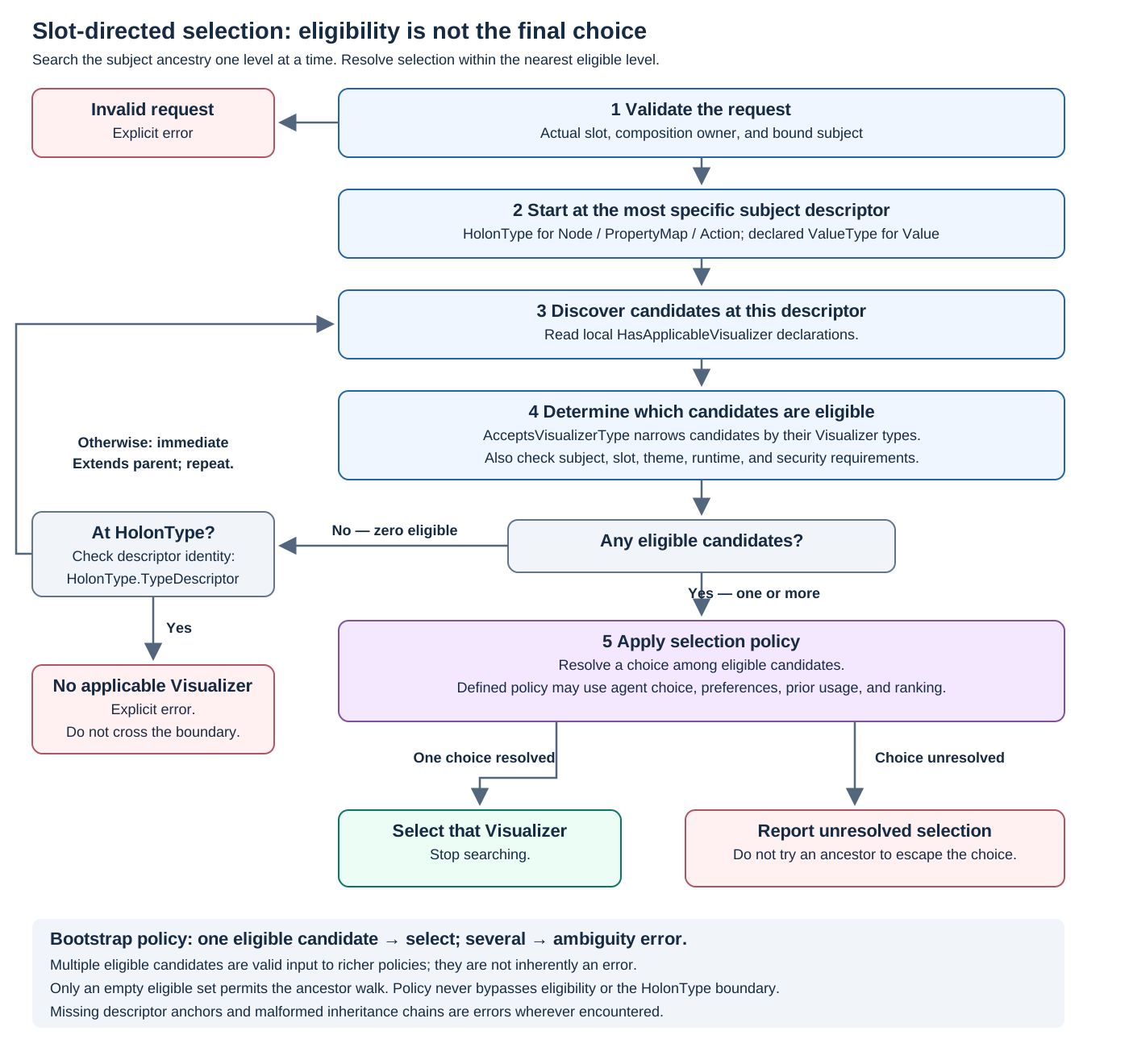
The loop follows the subject type's ancestry. Checking a candidate's Visualizer type against the slot is a separate filter inside that loop.
Identify the slot before looking for candidates.
The request names the actual VisualizerSlot, not just a role such as “Node.”
Its AcceptsVisualizerType relationships say which Visualizer types are allowed.
They narrow the candidate set; they do not choose a concrete Visualizer.
A separate role-name lookup must not supply a competing list of accepted types.
The Selector also checks that the slot belongs to the stated composition owner.
For a Visualizer, HasSlot identifies its child slots; for a Dancer, its explicit
role ownership supplies that check. The Selector must not choose a Visualizer
first and then search the parent's slots for somewhere to put it.
Search from the subject's most specific type toward more general types.
At each level:
- Discover candidates. Read the Visualizers declared applicable at that
descriptor, through its local
HasApplicableVisualizerrelationships. Do not combine all ancestors' candidates into one list; where a candidate is declared matters. - Determine eligibility. Filter against
AcceptsVisualizerType: a candidate'sDescribedBytype must equal or extend an accepted type. Apply the remaining subject, slot, theme, runtime, and security requirements. This establishes who may be selected, not who wins. - If no candidates are eligible, consider the parent descriptor. Continue
to the immediate
Extendsparent, including past a TypeKind definer with no eligible candidates, until HolonType has been checked. This is the only route to a more general descriptor. - Apply selection policy to the eligible candidates. Resolve a choice using the defined policy, which may consider explicit agent choice, preferences, prior usage, and ranking. These inputs distinguish otherwise eligible candidates; they do not waive eligibility requirements.
- Return the policy outcome. Select the one candidate the policy resolves. If it cannot resolve a choice, report an explicit unresolved-selection outcome. Do not choose by storage order or search an ancestor merely to escape an unresolved choice at this level.
The bootstrap policy is deliberately limited: it selects a sole eligible candidate and reports an ambiguity error if several remain. Multiple eligible candidates are not inherently an error in DAHN; a richer, defined selection policy can resolve them. No ranking algorithm is implied by this specification.
For example, suppose a Node slot is presenting a Book. Two Book Inspectors may both pass the slot and compatibility filters. A policy supporting an explicit conforming agent choice can select one; the bootstrap policy instead reports ambiguity. If neither Inspector is eligible, the Selector can try Book's immediate parent type, subject to the boundary below.
Continue past an empty TypeKind definer to HolonType.
A descriptor's local DefinesInstanceTypeKind = true designation establishes a
TypeKind definer (TKD); it does not block Visualizer fallback. The Selector checks
candidates at that descriptor just as at every other level. If an eligible
candidate is selected there, selection stops. If none qualifies, selection follows
the immediate Extends parent, continuing through any further TypeKind definers
to HolonType.TypeDescriptor.
HolonType is the final permitted level for holon subject lineages. Its candidates
are checked before reporting no applicable Visualizer; selection must not continue
to its TypeDescriptor parent. Descriptor lineages that do not include HolonType
end at lineage exhaustion. A missing starting descriptor or invalid inheritance
chain remains an error. An unresolved eligible set at a nearer level does not
permit searching a more general level.
Generic Holon Visualizers declare ApplicableToType only at HolonType. They do
not repeat applicability at DanceType, DanceResponseType, CommandType, OperatorType,
or Visualizer family anchors. Specialized Visualizers remain ordinary candidates
on the appropriate more specific descriptor. Every candidate must satisfy the
slot and compatibility requirements; no hard-coded implementation is substituted
when selection fails.
Use the descriptor appropriate to the subject.
The starting descriptor depends on what is being presented:
| Request | Where descriptor selection starts |
|---|---|
| Node, PropertyMap, or Action | The bound owner Holon's HolonType. |
| Value | The bound value's declared ValueType. |
The request may carry a subject-category tag so the receiving code can obtain the correct starting descriptor. That tag identifies the kind of input; it does not replace the slot's accepted-type requirements.
A PropertyMap can therefore request a String Visualizer for a PropertyName label and a separately typed Visualizer for the property's value. The PropertyDescriptor supplies metadata, without introducing a Property selector. Determining an array member's TypeKind is a separate lookup; it does not decide where a concrete Visualizer places array properties.
This descriptor walk governs descriptor-based child selection. Canvas launch and collection-subject selection retain their dedicated contracts.
14.2.2 Current descriptor candidate command contract¶
The bounded descriptor implementation exposes SelectVisualizer,
DiscoverVisualizers, and ChooseVisualizer through the existing transaction
command boundary. Their shared VisualizerSelectionRequest requires bound
subject, requested_kind, owner, slot, and theme references. owner is
explicitly tagged Visualizer or Dancer; the corresponding association is
HasSlot or HasExperienceVisualizerSlot. The Theme must have exactly one
ForMetaDesignSystem. The host derives available tokens from that MDS's
DefinesDesignToken and obtains local artifact availability from its existing
materializer catalog. Neither fact is a caller-provided boolean.
The current supported interpretations deliberately preserve the transitional implementation while the broader subject model remains the direction of §14.2.1:
| Requested kind | Starting descriptor |
|---|---|
| Node, PropertyMap, ActionBar, RootedNavigation | Subject's single DescribedBy HolonType |
| Property | Supplied PropertyDescriptor |
| Value | Supplied PropertyDescriptor's single ValueType |
| Action | Supplied Dance descriptor |
These interpretations do not establish a new permanent Property presentation layer or migrate Action to the target affording-holon model. Canvas, Collection, and home-Dancer bootstrap retain dedicated contracts and are not certified by these generic candidate operations.
Discovery returns candidates, current_selection, and the evaluated
ancestry. Each candidate carries its semantic visualizer reference, every
permitted declared_on descriptor contributing that identity, and one assessment:
viable, incompatible_slot, incompatible_theme, or
implementation_unavailable. Discovery traverses permitted ancestry even after
finding viable nearer candidates. Stable first encounter order conveys ancestry
provenance; it is not an affinity ranking or a future scoring contract.
An optional caller-captured current selection is returned separately. If its
identity remains applicable, its assessment reflects the same current evaluation.
Otherwise its assessment is no_longer_applicable with no contributing
declarations; it is not inserted into the candidate list. This is not mounted
state verification, a list token, or authority to choose it later.
Assessment first tests slot type compatibility, then exact consumed-token
coverage, then implementation availability. The first failing gate yields the
assessment; it does not exhaustively diagnose every later gate. An absent
ImplementedBy is implementation-unavailable. Multiple implementations, malformed
required metadata, missing required subject/Theme relationships, lookup failures,
cycles, and multiple Extends parents are evaluation errors for the operation,
not rejection scores. Required runtime, format, stable implementation key, entrypoint, and digest metadata
must be present and nonempty. Runtime metadata is an EnumValue; the other
implementation metadata fields are StringValues. Supported runtime and format
are TypeScript and ESModule.
Artifact presence is a read-only catalog/file check. It neither verifies digest
nor executes code, issues a handle, reserves an artifact, or certifies callable
behavior. Those checks remain at materialization/realization.
Automatic selection assesses one level at a time and selects its sole viable
candidate, reports ambiguity for multiple viable candidates, or continues when
none is viable. It does not inspect ancestors after success or ambiguity.
ChooseVisualizer independently resolves the new request, walks permitted
applicability, and assesses the requested identity using current facts. It may
choose a viable general ancestor despite nearer success or ambiguity. It fails
explicitly if the identity is no longer applicable or viable and never substitutes
another candidate. A successfully chosen candidate remains subject to subsequent
materialization and owner admission.
All three commands are read-only and follow existing bound-reference/lifecycle
rules, including saved-reference reads in retained committed contexts. They do
not stage, commit, write preferences, emit an adoption event, or replace a mounted
occurrence. The compatibility result's alternatives_available field is false
for automatic and explicit selection: these operations do not perform full
interactive discovery. Call discovery to obtain alternatives.
The Theme's presentation projection retains its exact semantic reference.
Callers provide the active reference at command time, including after an explicit
Theme switch; CSS values and key strings are not eligibility evidence. This does
not revalidate already mounted occurrences when a Theme changes.
14.3 Rust ownership¶
Visualizer selection belongs in Rust.
TypeScript must not independently resolve:
HolonType -> NodeVisualizer
or:
Properties -> PropertyMapVisualizer
or:
ValueType -> ValueVisualizer
or:
Dance -> ActionVisualizer
Before applying ordinary candidate policy, the Selector MUST exclude every Visualizer whose declared DesignToken dependencies are not all defined by the MetaDesignSystem established by the selected Theme. Selection consequently creates the runtime binding between a visualization request and a compatible Visualizer; neither a Dancer nor an application owns that binding.
TypeScript submits or triggers visualization requests and instantiates the implementation selected by Rust.
There must not be separate Rust and TypeScript selection authorities.
14.4 Initial deterministic bootstrap policy¶
Early implementation may deterministically select the sole compatible currently bundled applicable Visualizer. Multiple candidates are an explicit ambiguity until a ranking policy is defined, as specified in §14.2.1. It is ordinary candidate selection, not a fallback or a separate exceptional mechanism.
For example:
Node
    -> HolonInspectorVisualizer

Collection
    -> TableVisualizer
If no applicable Visualizer exists, selection fails explicitly because the visualization environment is incomplete.
The bootstrap policy must not be encoded as a permanent one-Visualizer-per-kind ontology.
14.5 Recursive selection¶
An illustrative composition is:
Active Holon -> Node slot -> selected Holon Inspector
    -> PropertyMap slot -> selected PropertyMap Visualizer
        -> label slot -> selected String Visualizer (PropertyName)
        -> value slot -> selected Value Visualizer (typed property value)
Each actual slot is independently resolved through the applicable service function. This example does not prescribe the child hierarchy of every Node or PropertyMap Visualizer. Requests need not cause one synchronous IPC round trip each: batching or reuse of still-valid Rust-authorized resolutions are execution strategies, not independent client-side selection authority.
14.6 Agent choice and selection policy¶
Eligibility precedes preference arbitration. When exactly one Visualizer is eligible under the applicable selection policy, Visualizer preferences do not change that choice. Where several candidates qualify, a selector function encapsulates the selection algorithm, including any individual and collective preferences it uses. That algorithm can become more sophisticated without changing the slot-to-selection contract or the subsequent usage-selection flow in §11.1. The bootstrap algorithm still reports unresolved ambiguity as defined in §14.2.1; this contract does not imply that preference ranking is implemented.
Agents may establish preferences, configure VisualizerUsage, choose another conforming candidate, save presets, and contribute usage history. A Human Agent may always override the selected candidate with another viable candidate. Preference scores do not veto that direct choice. Remembered choices supply personal affinity evidence for later selections; the applicable adaptive controls determine its influence, and only applicable pinned policy grants persistent precedence. An explicit choice is submitted to the Rust-owned selection authority and validated against the same slot, subject, theme, runtime, and security requirements. It does not authorize a parent or TypeScript client to bypass conformance or execution policy.
Personal ordering and Visualizer preferences, prior usage, governed aggregate salience/preferences, trend, maturity, release stability, novelty, and an explore/exploit policy may inform selection. Exploration or controlled randomness belongs to an explicitly defined future policy; it does not override the initial ambiguity error. Geometry capability may inform participation but does not make transient pixel allocation a renderer lookup table.
Persistent adaptive interpretation belongs to Rust as described in architecture adaptation. Immediate presentation adjustments remain local to the authorized owner.
14.7 Multi-level Visualizer information and choice¶
14.7.1 Stable action and presentation target¶
DAHN provides a semantic action for identifying the Visualizer presenting a
particular subject in a particular occurrence, and, where supported, choosing
another eligible Visualizer. Its initial visual symbol is a small lowercase v inside a
circle, comparable in scale to a conventional information icon. Each presented
slot selection has its own control bound to that selected Visualizer. Themes control its visual expression without changing the action's
meaning. The selected Visualizer's display name is shown in a tooltip above the circled v
on pointer hover and keyboard focus. The display name remains bound to the
control's occurrence; touch activation opens information without requiring a
tooltip. Visualizer definitions expose their display name and an optional
VisualizerDescription through their holonic property contract. This description
explains how that Visualizer fulfills a slot's purpose: its presentation approach
and distinguishing behavior, rather than restating the general task of the slot.
A slot exposes an optional VisualizerSlotDescription explaining the task and
purpose at that composition boundary, independently of the selected Visualizer.
The action has a meaningful accessible name, such as “Visualizer information”; final user-facing wording is a presentation convention, not a semantic identifier.
Each invocation identifies the presentation occurrence, its containing context, actual slot and owner, bound subject, and currently selected Visualizer. Shared subject or slot-definition identity alone is insufficient to identify an occurrence. The target must remain clear while the information is open, through labeling and, where useful, a temporary visual indication of the target region.
The immediate composition owner or runtime wrapper supplies the target-bound action. A selected Visualizer may expose that action through its own controls; independently authored Visualizers need not reconstruct selection or discovery semantics to participate.
14.7.2 Read-only information and optional choice¶
The information experience is useful independently of alternate selection. It identifies the current Visualizer by name, presents both the slot's purpose and the Visualizer's approach where their descriptions are available, identifies the subject being presented, and offers inspection of the Visualizer holon's additional properties. Shared Visualizer information must remain distinct from the selected usage's configuration and history. Presentation structure uses nested disclosures to show child presentation information in place. Expanding a child retains the containing Visualizer's information and supports further child disclosures without replacing the root information target. Several entries may remain open; collapsing one returns to its summary. Child definition exploration remains an explicit navigation action.
A read-only information box is a conforming realization of this capability; alternative discovery, preference scores, and replacement are not prerequisites.
When choice is supported and multiple eligible candidates exist, the experience can offer alternatives supplied by the authoritative selector. Inspecting a candidate and choosing it are distinct interactions. Optional preference scores or explanations come from the selector, with their meaning and individual or collective basis made clear; the presentation must not invent its own ranking.
An explicit choice passes through Rust-owned Visualizer selection and then VisualizerUsage selection (§11.1). Existing usage configuration is preserved; new usage is initialized only when no applicable prior usage exists. Choosing for one occurrence does not by itself establish a preference for every subject, type, space, or occurrence, or authorize changing a shared usage's configuration.
14.7.3 Access at composition levels¶
Universal access does not require a permanent icon on every rendered value. Each independently selected presentation can be identified through the action, but its concrete owner determines appropriate access through a header, contextual controls, an overflow menu, or inspection of the containing composition. Access must support keyboard operation and must not depend exclusively on hover or a pointer context menu. Nested access must preserve the distinction between the selected child and its containing presentation.
For example, a Holon Inspector selected for a NodeInspector slot has its own V entry point. Its ActionBar, Properties Pane, Collection Tabs bar, and Vertical Rail presentations can each expose the same action for their selected Visualizers. ActionGroup and Action children, and property-name and value children, remain identifiable without requiring a permanent icon beside every child. These are composition examples, not a mandatory internal hierarchy for all Node Visualizers.
A Collection View has an entry point for its selected Collection Visualizer, such as Table, Grid, or Gallery. Table owns the row presentation; rows do not have independent Row Visualizers or row-specific V controls. In a homogeneous holon collection, each property column has one declared ValueType and one selected Value Visualizer. Every cell in that column uses the same selected definition, with separate cell instances receiving their own values.
A compact V in the column heading identifies that selected Value Visualizer. Its tooltip gives the Visualizer display name, and inspection captures the column occurrence and identifies its scope as all rows in that column. No V is required in individual value cells. Sorting and row selection do not change the column's selected Visualizer or retarget an open inspection.
Column selection uses the authoritative PropertyDescriptor and declared ValueType through the Table's owned Value slot. Descriptor bindings remain separate from projected presentation values. Synthetic identity columns use the canonical identity-property descriptor. A projected column without an authoritative descriptor binding remains explicitly Table-owned; it must not claim a selected Value Visualizer based on runtime value tags.
Inspection does not itself authorize replacement. Future column-wide choices must use an explicit owner-defined contract and identify their scope; shared membership does not authorize replacement outside that column.
14.7.4 Composition, recursive access, and replacement boundaries¶
A Visualizer Inspector may compose a selected Structure explorer under its own owner-declared slot. The explorer explains the authoritative discovery evidence for the captured selection context; it does not introduce another discovery path or analyze historical selections or usage. Its organizing topology is the descriptor chain actually traversed by Rust and the candidate declarations on those levels, independent of a particular tree or level-list realization. “Explorer” does not itself introduce a new VisualizerKind.
Discovery evidence and explanation¶
The explorer's semantic subject is a Rust-created transient holonic projection of the existing discovery result. It retains the captured subject, actual slot, composition owner, Theme, currently presented Visualizer, visited descriptor levels in traversal order, candidate declaration provenance and eligibility, and the discovery endpoint and stopping reason. Where the current discovery result lacks explanatory evidence, capture that evidence in the same Rust operation; do not perform a second traversal to construct an explanation. Transport projection and binding follow the existing runtime boundaries.
Discovery and eligibility remain authoritative Rust responsibilities. TypeScript may resolve display labels and arrange supplied evidence, but MUST NOT reconstruct inheritance, compatibility, stopping policy, or selection rationale. Explanations use deterministic plain language grounded in that evidence; they do not require generated narrative. Explain why a candidate was identified separately from why a Visualizer was selected. A selection rationale may be shown only when actual selection evidence supports it; candidate availability alone is insufficient. Absent selection evidence is identified explicitly rather than inferred.
Automatic nearest-level selection continues to follow §14.2.1. Interactive discovery evaluates the permitted subject ancestry through HolonType inclusively for holon lineages, or through lineage exhaustion for other descriptor families; it does not stop at a nearer TypeKind definer. The supplied endpoint/reason distinguishes discovery termination from automatic selection stopping at the nearest eligible level. A Human Agent may explicitly choose any viable candidate in that population, including a general ancestor-declared candidate while a more specific candidate is viable. Automatic nearest-level precedence and ambiguity do not veto that choice. Applicability, the actual slot's requirements, Theme/MDS compatibility, runtime support, and execution authority still apply. Displayed eligibility is captured evidence; explicit choice revalidates current eligibility.
The candidate population contains only Visualizer types accepted by the actual slot. Other-kind applicability declarations encountered on the same visited lineage do not appear as unavailable choices. Matching-type candidates that fail Theme or implementation checks remain visible with their captured assessment. This filtering belongs to Rust discovery, not a second explorer-side traversal.
Explorer slot and state contract¶
The Visualizer Inspector owns the explorer's Structure slot and binds the discovery-evidence subject and current Theme through ordinary DAHN selection. Each realization identifies the current Visualizer and declaration provenance, explains specialized/general alternatives and the permitted boundary, and distinguishes viable candidates from unavailable ones. It exposes separate candidate Inspect and Choose actions through owner-supplied capabilities bound to the original captured occurrence. It supports explicit initialization, acceptance of the parent's bounded allocation, safe dismissal, and its own v information action. Node-specific compression or collection obligations do not become explorer requirements merely because an existing Node hosting path implements replacement.
The slot accepts DiscoveryExplorerVisualizer.HolonType, a Structure subtype encoding this participation contract. Broad Structure ancestry alone is not sufficient: a RootedNavigation Visualizer such as Path Inspector requires its own navigation owner and does not fulfill this explorer contract. Rust applies the actual slot's accepted type when identifying candidates.
When recursive discovery captures a transaction-local subject, project its evidence in that subject's source transaction. The nested Inspector borrows this semantic context; it must not dispose its parent's transaction. The top-level Inspector retains ownership of the complete chain and releases the source context when the chain is closed. Presentation transactions remain independently disposable. Saved-only evidence may use a private projection transaction. Replacement failures remain visible beside the attempted choice.
Opening, reopening, or refreshing the discovery explanation is a read-only information interaction. It may resolve existing VisualizerUsage configuration, but must not create a new usage, resume pending writes, or commit merely to show the explanation. If no completed usage exists, render with presentation defaults. An explicit explorer choice continues to use ordinary usage initialization and successful-use reporting; this rule does not change Commit performance policy.
Changing a Visualizer changes presentation while preserving its semantic subject, supplied information, and externally owned contracted interaction state. Switching explorer realizations MUST retain the same captured discovery evidence, original request context, selected candidate or declaration, candidate-preview target, and containing inspection-session chain. The composition owner retains this state by semantic reference and supplies it to the replacement. The replacement makes the retained selection visible or readily accessible. Implementation-private tree expansion, scroll position, and layout may reset.
Switching presentation does not refresh discovery. Explicit refresh and a successful choice may update the evidence for the same captured context. If updated evidence no longer contains a selected candidate or declaration, identify that change and clear the invalid selection explicitly. Reading or previewing evidence does not itself choose a Visualizer or update usage preferences.
Recursive inspection and resource ownership¶
The explorer exposes its own v information action. Each invocation captures a distinct target: choosing another explorer realization MUST NOT change the original subject's Visualizer. Further information sessions open only through explicit interaction.
One top-level Visualizer Inspector session owns all descendant explorer resources, nested inspection sessions and their retained state, pending work, and transient presentation resources. Nested inspection uses a retained session stack within the existing information region. Only the current information session is mounted; suspended sessions retain semantic targets and contracted state and release presentation resources, which are realized again on return. Disposal releases owned resources, not externally owned subject transactions or shared usage. Back or nested dismissal disposes that nested session and restores its parent. It restores focus to a live invoking v, its replacement counterpart, or an appropriate containing control.
An explicit v invocation from the main viewing area disposes the entire prior top-level Inspector session before establishing a new target. Closing the information experience, invalidating its top-level target, or disposing its host also clears the complete owned chain. Invalidating a nested target disposes that session and its dependents and returns to the nearest surviving parent. Replacement invalidates inspection targets bound to the retired realization; the returning parent retains its semantic context and replacement explorer.
All exit paths use the same idempotent ownership/disposal operation. It cancels pending work, clears owned stacks, releases realizations/listeners/observers and transient resources, and rejects late publication. Work that completes after cancellation releases its prepared resources rather than adopting another session's target. Nested depth is explicitly bounded by the host; reaching the bound leaves the current session usable and creates no additional resources.
Replacement preserves the target's subject and occurrence identity, containing context, and parent allocation authority. Externally owned staged or transaction state must not be discarded by replacement. Navigation or selection state is transferred only where a shared contract supports it; arbitrary implementation- private state transfer is not promised. A failed selection or realization must leave the existing presentation usable, subject to applicable authorization, and report the failure. A result for a closed or superseded target must not be applied to another occurrence.
A replacement is ready only after its explicit initialization completes successfully, required participation is validated, and it accepts the current parent allocation. The owner keeps the prior presentation usable during preparation. Immediately before publication it rechecks target liveness, request generation, and active-interaction dismissal guards. Publication transfers presentation ownership; the prior realization is then disposed. Failed or superseded preparations release their resources. Readiness does not require a browser-paint guarantee. An interaction that cannot safely dismiss prevents replacement while leaving the current presentation usable.
Occurrence identity, topology, focus, allocation/compression, and externally owned staged edits remain with their existing owners. Selected collection/rail targets and collection sort/filter/selection survive only through shared state contracts. Implementation-private presentation state may reset; it must not carry the only copy of externally owned edits or contracted navigation state.
Viability assessment and runtime admission¶
Viability includes the participation contract required by the actual slot, not only subject applicability and an accepted Visualizer type. Candidate assessment uses authoritative declarations and known runtime capabilities; it is distinct from validating the selected materialized realization before admission. A compatible declaration is not proof that executable behavior fulfills its promises. Missing bindings, unsupported required inputs, and violated behavioral contracts require explicit failures; preference scores cannot compensate for them.
The deferred Visualizer composition-contract proposal formalizes this distinction through slot-required and candidate-offered Visualizer Operators, identity-based callable bindings, and operation-specific input/result and behavioral contracts. It is design evidence, not an adopted schema or current implementation capability. Selection evaluation must leave room for those participation checks without requiring adoption of that proposal or substituting ad hoc method names for semantic contracts. Formalized required contracts, when adopted, belong to viability rather than weighted affinity. Exact allocation and operation admission remain the owning composition/runtime responsibility; structural declarations alone do not prove accessibility, state survival, or arbitrary implementation conformance.
14.8 Adaptive Interaction Reporting¶
Ordinary personalization and navigation interactions can provide evidence without requiring preference surveys. A Visualizer SHOULD report the semantic meaning of supported adaptive interactions rather than raw pointer movement or an undifferentiated usage counter. Reporting carries the relevant agent/space context, subject or descriptor, actual Visualizer and occurrence, action or choice, scope, and outcome as applicable. Exact event schemas remain open.
Candidate enumeration, inspecting an alternative, submitting a choice, authorizing that choice, and successfully realizing it are distinct events. Successful choice/adoption evidence MUST NOT be inferred from discovery or validation alone. Failed or cancelled realization must not be counted as successful use. Repeated transport delivery must not create repeated preference evidence; event correlation and deduplication belong to the reporting contract.
TypeScript applies immediate presentation consequences locally where the interaction contract permits, respecting asynchronous realization/admission and state-survival guards. Rust interprets adaptive meaning. Local responsiveness SHOULD NOT wait for preference persistence or collective aggregation, but local feedback does not authorize semantic selection, mutation, or execution.
Successful-use reporting and preference persistence are best-effort consequences of presentation. Their failure MUST NOT block the agent's primary task, undo a successfully published replacement, remove its usable configuration, or require corrective action before interaction continues. The consequence may be missing usage evidence or future defaults. This does not relax preparation of the usage and configuration required to realize a participant.
Retry safely in the background within bounded limits. A warning is appropriate only when it provides a meaningful corrective action, such as retrying preference capture. It must be mild, dismissible, and non-modal, without stealing focus or making the primary task depend on dismissal or retry. Failures without a useful corrective action remain in diagnostics.
Each published choice carries its occurrence identity and an ordered choice token for reporting. Rust deduplicates repeat delivery and prevents an older choice or retry from overwriting a newer remembered preference. Ordering covers all occurrences sharing the local-space slot and exact subject descriptor; a per-occurrence counter alone is insufficient. Retries retain their original identity/order and do not become new choices. Unpublished or cancelled choices provide no successful-use evidence. Reporting eligibility and configuration validation remain under existing Rust authority.
An occurrence change, a request to remember a preference, a pin/reset, and consent to collective contribution express different intentions. Reporting a choice MUST NOT implicitly persist all of them. Preference matching and invalidation must retain the applicable slot, subject, and context constraints; choice history does not widen permitted subject ancestry or silently change nearest-level automatic selection. Interactive ancestor alternatives follow §14.7.4; remembering the direct choice does not itself pin future selections.
For example, moving a property may suggest salience; choosing another Visualizer may suggest preference affinity; deliberately grouping actions or arranging Structure nodes may suggest association. Inference is contextual evidence, not certainty about durable intent. Aggregation observes the agent-control and sharing constraints in adaptive human experience.
15. Visualizer Composition¶
A selected Visualizer determines its internal composition.
Its responsibilities include:
- defining Slots;
- assigning internal geometry;
- determining which semantic affordances populate each Slot;
- creating child visualization requests;
- responding to parent allocation changes.
The parent Visualizer determines its visual composition and allocates its received spatial budget among the roles it realizes.
The Visualizer Selection Service selects the child semantic Visualizer; Rust implementation resolution supplies its authorized executable realization.
A visualizer is therefore both a part, receiving an external allocation from its enclosing visual context, and a whole, allocating that budget among its own fulfilled visual roles. Persisted layout is separate future semantic data when a person's arrangement itself becomes meaningful.
16. HolonInspectorVisualizer¶
The Holon Inspector specification owns this concrete behavior. It does not constrain other Node Visualizers or establish a universal DAHN presentation grammar.
17. HolonInspectorVisualizer Slots¶
The Holon Inspector specification owns this concrete behavior. It does not constrain other Node Visualizers or establish a universal DAHN presentation grammar.
18. HolonInspectorVisualizer Descriptor Projection¶
The Holon Inspector specification owns this concrete behavior. It does not constrain other Node Visualizers or establish a universal DAHN presentation grammar.
19. Structural Cardinality Invariant¶
These axis-specific rules belong to Path Inspector. DAHN supplies semantic cardinality and composition mechanisms without imposing a universal navigation axis. The Holon Inspector realization owns its affordance placement; the selected RootedNavigation Visualizer owns the navigation effect.
20. PropertyMapSlot¶
A Holon Inspector PropertyMapSlot binds its owner Holon's property facet. Its selector uses that Holon's type and effective descriptors; the child realizes the actual bound data. The PropertyMap kind defines the set-level semantic boundary. Concrete child layout belongs to the selected PropertyMap Visualizer.
21. PropertyMapVisualizer¶
PropertyMap owns set-level presentation.
DefaultPropertyMapVisualizer.PropertyMapVisualizer names the current default
candidate; default applicability is ordinary selection policy, not a fixed
layout, column count, or hard-coded fallback.
22. Property Label and Value Slots¶
A PropertyMap Visualizer may compose a String label for PropertyName alongside a ValueType-specific value Visualizer. These are separate bindings and selection boundaries, described by the PropertyMap kind. The PropertyMap owns pairing, layout, label placement, and applicable typography constraints. The children own their rendering and permitted interaction.
PropertyDescriptor metadata remains selection/binding context. There is no intervening Property VisualizerKind or Property selector. A property row may remain an internal layout construct; its name/value pairing alone does not require a separately selected renderer.
23. ValueVisualizer¶
The Value kind defines value visualization; String is a specialization. ValueType, actual value, role, optional PropertyDescriptor and Holon context, view/edit mode, and agent preferences inform selection. They do not dictate one renderer.
For example, a publicationDate value can be bound to an appropriate temporal Value Visualizer through its PropertyMap owner's value slot. Its PropertyName label is a different String subject and does not become editable merely because its renderer also supports editing string values.
24. Action Bar and ActionVisualizer¶
The Holon Inspector specification owns this concrete behavior. It does not constrain other Node Visualizers or establish a universal DAHN presentation grammar.
25. Collection Tabs¶
The Holon Inspector specification owns this concrete behavior. It does not constrain other Node Visualizers or establish a universal DAHN presentation grammar.
26. Collection Viewer¶
The Holon Inspector specification owns this concrete behavior. It does not constrain other Node Visualizers or establish a universal DAHN presentation grammar.
27. Collection and Structure Visualizers¶
The Collection kind owns homogeneous Holon or value collections. The Structure kind owns subjects unified by semantic topology. Rendering something as a graph, table, or map does not alone establish its semantic kind.
27.1 Rooted Navigation Visualizer¶
RootedNavigation is a Structure specialization alongside Graph and Geospatial. The kind contract is independent of HolonSpace; Path Inspector is one concrete realization with its own grammar.
28. Node Navigation Semantics¶
These axis-specific rules belong to Path Inspector. DAHN supplies semantic cardinality and composition mechanisms without imposing a universal navigation axis. The Holon Inspector realization owns its affordance placement; the selected RootedNavigation Visualizer owns the navigation effect.
29. Canvas, Dancer, and Rooted-Navigation Responsibilities¶
29.1 DAHN Composition Authorities¶
The conceptual experience stack is:
DAHN Experience
    -> Window Manager
    -> Window / Viewport (top-level experiential context)
    -> Canvas
    -> Composition / Navigation Surface
    -> Visualizer Occurrences
    -> Visualizer Slots
    -> Child Visualizers
These are authority and contract boundaries, not a requirement for one UI component per level. A Dancer composes experience roles hosted within this stack; selected visualizers may recursively own composition surfaces.
The Window Manager owns top-level experiential-context creation/destruction, finite display allocation, context placement and switching, and maximize/restore/minimize where supported. A conventional window is only one realization: tabs, tiles, single-context switching, multiple displays, spatial volumes, rooms, or immersive contexts MAY implement the same authority. It grants each Canvas a bounded viewport/allocation.
A Canvas owns composition inside its granted context: hosted-role placement, child allocations, composition-surface extent, view transformation, focus projection, and recovery of off-viewport content. It MUST NOT assume ownership of the whole DAHN display. Expansion beyond its grant is a request to the Window Manager. A selected RootedNavigation visualizer may own a nested navigation surface and its layout/view operations; Canvas authority does not permit reaching through that boundary to manipulate its geometry.
A Dancer may own multiple exploration tabs inside its existing hosted experience. Such tabs are Dancer-owned composition, not additional Window Manager contexts. The Dancer owns each tab's role slot and inherited experience context; the selected Visualizer owns its internal topology and geometry. Space Navigator's exploration contract defines its tab lifecycle and shared read-transaction ownership.
29.2 Surface, Layout, and View¶
The spatial model is:
Navigation Topology
    -> Navigation Layout
    -> Navigation Surface
    <-> View Transform
    -> Viewport
    -> Human-visible projection
A Composition Surface contains a spatial realization; a Navigation Surface is its rooted-navigation specialization. A Viewport is the finite view onto that potentially larger surface. Layout determines placement and allocation. The View Transform determines view position and scale. Panning/scrolling and zooming MUST NOT inherently recompute layout or change allocation, compression, or topology.
A Visualizer at 50% zoom is not a compressed Visualizer. Compression reduces allocation and may invoke a different responsive realization; zoom preserves layout and allocation. Surface growth beyond the viewport is permitted. An uncompressed Visualizer MAY declare or negotiate its minimum useful extent. As an illustration, the Path Inspector application of this contract protects an open Holon Inspector from being forced below that extent solely by viewport exhaustion (Path Inspector §4.6). Exact dimensions remain presentation decisions.
Canvas-level zoom-to-fit changes only view scale and, as needed, position to fit the relevant surface extent. It MUST preserve topology, occurrence budgets, compression, and layout geometry. focus/actual-size returns to the normal useful scale and centers the active/open occurrence; other occurrences may then be off-viewport and reachable by pan or Zoom to Fit. For nested surfaces these requests are handled by the composition owner of that surface.
30. Parent-Owned Allocation¶
Every composition host owns external allocation and placement of its immediate children and grants a budget/context through a slot. Children own internal realization, MAY report minimum/preferred extents and supported presentations, and MUST respect their granted allocation.
Three operations have distinct authority:
| Operation | Authority and effect |
|---|---|
maximize-region(occurrence, region) / local restore |
The Visualizer redistributes only its existing allocation among internal regions; restore returns its prior local composition. |
| Canvas focus / occurrence maximize | The composition host gives an occurrence dominant attention in its viewport, preserving surrounding topology; any allocation change is explicit and distinct from a view-only focus/actual-size operation. |
| Window/context maximize / restore | The Window Manager changes the context's share of the DAHN display where supported. |
A participant MAY redistribute resources it owns; expansion beyond that boundary MUST be requested from its parent authority. Requests may propagate through hosts without bypassing them. Local maximization MUST NOT silently become global maximization or topology removal.
Independent restoration and request outcomes¶
Each authority MUST retain its own restore information: the Visualizer owns local region composition; Canvas and hosted composition owners own their attention projection and view; the Context Host / Window Manager owns the prior host grant. Sequential operations at different levels MUST retain independent restore state rather than one global restore snapshot.
Local maximize/restore MUST preserve occurrence identity and mounted child state. Restore recovers the prior internal arrangement within the current parent grant; it MUST NOT reinstate a stale larger allocation. Local maximize invokes neither Canvas attention nor context maximize.
Canvas attention MUST preserve retained branches, occurrence identities, and semantic state, and remain within its finite grant even when that grant covers only part of the display. Prior active-occurrence, view-transform, and any Canvas-owned temporary projection state MUST remain recoverable. Allocation changes, if any, MUST be explicit. Requests affecting a nested surface pass through its owning composition contract; Canvas does not edit that owner's private geometry. Attention does not implicitly maximize the context.
Context maximize/restore uses an explicit parent request. A granted request revises the finite allocation delivered to Canvas; the host does not directly edit descendant composition, topology, or semantic state. Unsupported or refused requests preserve the last valid grant, usable presentation, and local restore information. They MUST NOT trigger speculative layout or silently substitute a different operation. Requests crossing authority boundaries return explicit results and never bypass an intermediate owner.
View-only focus/actual-size is separate from allocation-changing restoration:
it centers the active/open occurrence through position and scale, with actual
size using scale 1.0. It MUST NOT inherently recompute navigation layout or
compression, change occurrence allocation/topology, or invoke context maximize.
All these presentation operations preserve semantic and staged state; none
implies mutation, commit, abandon, or revert.
30.1 Layout Budgets and Participation¶
A Visualizer Slot is an experiential participation contract, not merely a structural placeholder or a HolonType match. Its requirements can combine semantic role, required capabilities, supplied experiential context, allocation, and interaction obligations. Independently authored Visualizers from federated Commons must satisfy the slot/context in which they participate.
Possible contract dimensions include budget responsiveness, minimum/preferred or intrinsic sizing, compact and focus capabilities, inherited theme/design tokens, accessibility, input conventions, and state-survival obligations. This list is illustrative, not a finalized schema. Semantic capability requirements and subsequent real-estate negotiation remain distinct from selecting a Visualizer by transient pixel dimensions. The contract MUST leave room for future formalization without prescribing child internals.
A conceptual allocation budget may include width, height, minimum/maximum bounds, orientation, density, and overflow constraints. Visualizers may declare minimum useful and preferred extents, preferred aspect ratio, supported density, compact/compression/scrolling capabilities, and alternate action presentation. These are possible participation dimensions, not a finalized universal schema. The parent uses applicable capabilities to allocate; the child determines its internal responsive composition. Kind and semantic eligibility remain distinct from transient pixel allocation. These responsibilities recur at every level.
31. Compression and Visualizer Identity¶
The selected Visualizer identity survives:
- partial compression;
- full compression;
- scanning;
- overflow;
- maximization;
- restore.
The Visualizer Selection Service should not ordinarily select separate Visualizers such as:
FullNodeVisualizer
RailOnlyNodeVisualizer
CollectionsOnlyNodeVisualizer
CompressedNodeVisualizer
for projection-state changes.
Instead:
HolonInspectorVisualizer
    +
current allocation
    ->
appropriate internal realization
Another Node Visualizer may realize the same allocation states differently.
31.1 Independent State and Experiential Authority¶
Topology, layout/allocation, and view are independent state dimensions. Inspect/traverse/branch/close affect topology; placement, compression, minimum and surface extents affect layout; pan, zoom, viewport and attention affect view. A semantic interaction may explicitly coordinate dimensions, but they MUST NOT be collapsed into one enumerated state machine.
Compression, focus, local maximization, off-viewport placement, or zoom MUST NOT implicitly discard occurrence/navigation state or semantic/staged state. Closing an occurrence follows its owner's interaction grammar; it does not dispose of externally owned Nursery/transaction state. Context destruction likewise is not implicit transaction abandonment; any semantic disposal follows its owner's explicit contract.
These boundaries preserve experiential sovereignty: no Visualizer seizes global space, no Canvas commandeers its Window Manager, and inherited experiential policies remain under person/context control. Standardize the seams, not the implementations. This is not a universal visual design system. Infinite 2D, grid, tiling, radial, focus+context, timeline, 3D, and immersive Canvases and alternative Window Managers remain valid if they preserve these obligations.
32. HolonInspectorVisualizer Extent Realization¶
The Holon Inspector specification owns this concrete behavior. It does not constrain other Node Visualizers or establish a universal DAHN presentation grammar.
33. Visualizer Runtime Contract¶
A dynamically instantiated Visualizer requires a stable DAHN runtime contract.
The exact TypeScript API may evolve, but it should provide only the capabilities required by the Visualizer.
Possible capabilities include:
read descriptor
read value
traverse relationship
invoke Dance
request navigation
stage edit
request child visualization
report interaction
request local layout change
The runtime protocol should avoid exposing unrestricted host capabilities. Client execution responsibilities include cache lookup, module loading, protocol compatibility checks, and execution isolation. Failure to load an authorized realization is reported explicitly; the runtime does not substitute another Visualizer or implementation.
34. Visualizer Runtime Security Boundary¶
Artifact provenance establishes what code is executing.
It does not establish that the code is safe.
Therefore contributed Visualizers should eventually execute through constrained DAHN capabilities rather than automatically receiving unrestricted access to:
- filesystem;
- shell;
- arbitrary networking;
- arbitrary Tauri commands;
- conductor internals;
- unrestricted MAP APIs.
Trust and compatibility concerns include provenance, signing/code integrity, version compatibility, sandboxing and runtime permissions, dependency isolation, and controlled acquisition. Semantic applicability alone does not establish runtime executability. Bootstrap limitations do not waive the verification or execution-authorization boundary.
The Visualizer Runtime Protocol is therefore both:
- an interoperability contract;
- an execution-authority boundary.
35. Visualizer Definition and Stewardship¶
Visualizer definitions should be treated as semantic MAP resources rather than permanently as compile-time TypeScript objects.
A Visualizer definition may eventually include:
identity
version
VisualizerKind
Slots
applicability
Visualizer protocol version
implementation artifact
steward
signatures
compatibility metadata
Early implementations may bootstrap these definitions locally.
That bootstrap representation must not become the permanent architecture.
36. Visualizer Commons¶
Visualizers are expected eventually to be stewarded in federated Commons.
Commons can provide:
- independently contributed MetaDesignSystems and Themes;
- Theme availability for Human Agent selection in applicable HolonSpaces;
- Visualizer discovery;
- descriptions;
- versions;
- VisualizerKind;
- applicability;
- stewardship;
- provenance;
- endorsements;
- implementation metadata;
- artifact locations.
The Visualizer Selection Service may use such information when choosing among candidate Visualizers. A Commons-provided Theme establishes the effective MDS whose guaranteed DesignToken set constrains that selection; neither contribution is owned by an application or Dancer.
37. Visualizer Implementation Artifacts¶
A Visualizer implementation should be treated as an immutable executable artifact.
Its executable artifact identity should be content-based, not URL-based. The Visualizer Holon retains its distinct MAP identity across implementations and artifact revisions; digest identity is not semantic Visualizer identity.
Conceptually:
Visualizer
    implementation
        artifact digest
        artifact format
        entry point
        protocol version
        signer
        signature
        artifact locations
A URL answers:
Where might these bytes currently be obtained?
It does not answer:
What executable artifact is this?
38. Content-Addressed Identity¶
Visualizer implementation artifacts should be identified by digest.
For example:
SHA-256 = abc123...
Any source returning bytes matching that digest has supplied the same immutable artifact.
Changing the executable produces a new artifact identity.
This allows:
- deterministic caching;
- mirroring;
- distributed acquisition;
- offline reuse;
- transport independence.
39. Distribution Does Not Imply Authority¶
Artifact stewardship and artifact transport are separate concerns.
A Visualizer artifact may be available from:
- local cache;
- MAP artifact provider;
- steward-hosted service;
- mirror;
- HTTPS;
- content-addressed storage;
- other future transports.
An untrusted mirror can safely distribute an artifact if the runtime verifies that the bytes match the selected digest.
Authority comes from MAP identity, stewardship, signatures, and policy.
Transport supplies bytes.
40. Visualizer Artifact Loading¶
The intended loading flow is:
visualization request
    |
    v
Rust Visualizer Selection Service
    |
    v
selected Visualizer
    |
    v
implementation resolution
    |
    v
artifact acquisition
    |
    v
digest/signature verification
    |
    v
immutable local cache
    |
    v
DAHN-controlled runtime module handle
    |
    v
TypeScript dynamic import / activation
    |
    v
Visualizer Protocol validation
    |
    v
Visualizer instantiation
TypeScript does not independently discover or authorize implementation artifacts.
40.1 Materialization and Client Caching¶
Materialization is distinct from selection. A Visualizer-afforded
Materialize Dance asks Rust/MAP to retrieve the executable realization for
one already-selected Visualizer Holon and the current supported runtime.
The materialization result is a typed realization payload. It MAY contain JavaScript code, module format, and entry-point information in the initial local-artifact implementation. It SHOULD remain extensible for immutable artifact identity, provenance, trust, and storage-location information.
Rust owns retrieval and materialization policy. TypeScript MAY cache a successfully materialized module by the selected Visualizer's semantic identity and may use a valid authorized cache entry before requesting Materialize again. The cache is not a semantic registry: it MUST NOT choose a different Visualizer, implementation, or fallback, and client cache bookkeeping does not confer semantic selection authority.
The first materializer MAY read local filesystem artifacts. That is an implementation backend, not the long-term semantic or storage model. MAP-space stewardship, IPFS or other artifact stores, provenance verification, and sandboxing remain independently evolvable behind this Dance boundary.
A semantic-identity lookup must resolve to the authorized implementation/version and verified artifact, not treat a mutable Holon identity as an immutable code identity. Digest/signature and protocol checks precede execution as specified here. A local artifact backend does not waive these trust boundaries.
41. DAHN-Controlled Module Materialization¶
A verified Visualizer artifact may be exposed to the WebView through a DAHN-controlled local or custom protocol.
Conceptually:
map-visualizer://sha256/abc123/index.js
Such a URL is a runtime handle, not the Visualizer's semantic identity.
Its meaning is approximately:
DAHN has resolved and verified the artifact having this content identity and made it available for frontend execution.
42. Visualizer Protocol Compatibility¶
A dynamically loaded Visualizer must declare the Visualizer Protocol version it implements.
The DAHN runtime must reject incompatible implementations.
A standard module entry point should be defined.
Conceptually:
createVisualizer(context)
The exact contract belongs to implementation-level refinement.
43. Relationship to Dynamic Dance Implementations¶
Dynamic Dance implementations and Visualizer implementations share a common higher-level executable-artifact model.
MAP executable artifact semantics
            |
    +-------+-------+
    |               |
  Dance          Visualizer
  WASM               JS
    |               |
sandbox         UI runtime
    |               |
Dance Protocol  Visualizer Protocol
Common principles include:
- immutable artifact identity;
- content addressing;
- agent stewardship;
- digital signatures;
- provenance;
- runtime policy;
- constrained execution protocols.
The runtime technologies differ, but the MAP trust and artifact model can remain coherent.
44. Initial Bootstrap Visualizers¶
The initial DAHN implementation should provide deterministic bootstrap
Visualizers sufficient to prove the architecture. The current Node strategy is
HolonInspectorVisualizer; the current Collection strategy is
TableVisualizer. Future candidates participate in the same selection space,
with increasingly general applicability considered only as selection policy.
Exact implementation sequencing belongs in implementation plans. If no applicable and runnable Visualizer remains after policy evaluates the available candidates, selection fails explicitly.
45. Design Tokens, Meta Design Systems, and Theme Ownership¶
DAHN presentation is grounded in a three-part model:
DesignToken
    -> reusable named semantic presentation decision
MetaDesignSystem
    -> versioned contract defining a complete token vocabulary
Theme
    -> user-selectable complete typed value assignment for one MDS
DAHN stewards the DesignToken language and the schema contracts for all three concepts. It does not own every MDS or Theme instance: those are independently contributed presentation artifacts, including artifacts published through Visualizer Commons.
45.1 Design Tokens¶
A DesignToken names what presentation decision is requested, not how a
component implements it. Examples include Surface, Text, Focus, and
Space; its identity is neither a CSS property nor a Theme value.
Every DesignToken has exactly one DesignTokenType. The initial types are
Color, Dimension, FontFamily, FontWeight, and StrokeStyle. They are
narrowly aligned with the equivalent DTCG token-type concepts. DesignTokenType
is MAP's first-class value classification, not a claim of complete DTCG
vocabulary or DTCG serialization conformance.
Design Tokens belong to a reusable vocabulary package with no dependency on Themes or Meta Design Systems. A token may consequently be defined by many MDSs; MDS membership does not establish token ownership.
45.2 Meta Design System Contract¶
A MetaDesignSystem (MDS) is a versioned semantic presentation contract. Its
DefinesDesignToken relationships identify the full set of token roles
available to its Canvases, Themes, and supporting Visualizers. A change in the
meaning of an existing role requires a new MDS version rather than a silent
reinterpretation.
MDS is MAP-native composition vocabulary. DTCG standardizes design-token concepts and interchange formats, but does not standardize a MetaDesignSystem entity.
The effective MDS for a Canvas is established at runtime by its selected Theme's
ForMetaDesignSystem relationship. UsesMetaDesignSystem, where materialized
on a Canvas, records that effective runtime contract rather than a static
application configuration. A Visualizer declares dependencies on the specific
DesignTokens it consumes; it does not depend on an MDS identity. A Visualizer
is compatible with an effective MDS exactly when every declared token
dependency is among that MDS's DefinesDesignToken targets. The MDS therefore
states the complete token subset guaranteed to have values in a compatible
Theme, while ConsumesDesignToken makes each Visualizer dependency explicit.
Normatively:
selected Theme --ForMetaDesignSystem--> one effective MDS
effective MDS --DefinesDesignToken--> its guaranteed DesignToken set
Visualizer --ConsumesDesignToken--> its required DesignToken set
The Selector may select a Visualizer only when the Visualizer's complete required DesignToken set is a subset of the effective MDS's guaranteed set.
45.3 Themes and Complete Assignment¶
A Theme realizes exactly one MDS through ForMetaDesignSystem. It owns
ThemeTokenAssignment intersection holons, each of which binds exactly one
Theme, one DesignToken, and a concrete PresentationValue. The assignment's
semantic identity is the ordered (Theme, DesignToken) pair.
A Theme is valid for its MDS when, and only when, it has exactly one assignment for every DesignToken defined by that MDS, and no assignments for other tokens. Each assigned value must conform to that token's DesignTokenType. These are schema validation rules, not optional runtime fallbacks.
This direct Theme-to-MDS dependency is intentional: it states the compatibility contract explicitly and permits independent evolution of token vocabulary, MDSs, and Themes without binding a Theme to a Dancer.
MDS and Theme instances are contributed presentation content. Their identities, values, and availability are not application-owned and are not Core bootstrap instances merely because DAHN supplies their schema contracts.
45.4 Theme Selection and Runtime Projection¶
Theme selection is person- and space-driven, orthogonal to Dancer choice. A
HolonSpace may OffersTheme to make Themes available; Themes are not supplied
by Dancers and do not have their own synthetic HolonSpace. The Human Agent
selects one offered Theme. That Theme's ForMetaDesignSystem target establishes
the effective MDS passed to the DAHN Selector with every visualization request.
The initial POC uses the sole Theme offered by the active HolonSpace. A future
space with several offered Themes presents a choice to the person;
personal-preference persistence is deliberately outside this initial model.
Locally bundled presentation contributions may supply the initial MDS and Theme
before Commons discovery exists, but their loading and OfferedByHolonSpace
lifecycle are presentation concerns, not Dancer or application policy. The
offer edge is staged in its normal transaction and persists through that
transaction's normal commit.
On Canvas initialization, the runtime resolves the applicable Theme and invokes the Theme wrapper's single projection operation to generate the fixed CSS custom-property representation. That Theme graph is resolved once, not on every Visualizer render. It refreshes only after an explicit Theme change or version refresh. Visualizers consume these semantic token values and may derive their internal presentation from them, preserving compatibility with independently developed Visualizers.
45.5 Theme and Composition Boundaries¶
Each Dancer declares the DesignTokens on which its experience depends so Canvas can evaluate hosting compatibility. Visualizers declare the tokens required by their own realizations; the compatibility rule above applies to all such requirements. Theme values may influence typography, spacing, density, icons, control sizes, colors, borders, elevation, and interaction-state presentation. Visualizers consume semantic tokens rather than hard-coded stylistic constants.
Theme changes do not redefine semantic roles or cardinality. Layout and experiential grammar remain with the relevant composition owner; the theme provides compatible presentation values.
46. DAHN Runtime Orchestration¶
The DAHN runtime coordinates:
- obtaining a semantic subject;
- creating a visualization request;
- invoking the applicable DAHN Visualizer Selection Service function;
- resolving the selected Visualizer;
- ensuring its implementation is available and verified;
- instantiating the Visualizer;
- binding the semantic subject and runtime context;
- assigning external allocation;
- allowing the Visualizer to recursively request child Visualizers.
A Visualizer should not independently recreate these host responsibilities.
47. Holon Access¶
DAHN should remain reference-centered.
The default posture is:
- authoritative Holon state in Rust;
- transaction-bound public
HolonReferenceobjects in TypeScript; - plural results represented through
HolonCollection; - functional reads when required;
- small derived TypeScript presentation state;
- no eager full-Holon snapshot as the primary DAHN model.
Descriptor access should likewise remain reference-backed or use deliberately bounded presentational projections.
48. Lazy Semantic Expansion¶
Rendering an Active Holon's descriptor must not require eagerly traversing all semantic affordances.
For example:
- discovering a plural Relationship may create a Collection Tab without loading its members;
- discovering a plural navigational Dance may create a Collection Tab without invoking the Dance;
- Collection contents are resolved when the user activates the affordance.
This preserves scalability and aligns with the Space Navigator's inspect-then-navigate interaction model.
49. Commands and Dances¶
DAHN should treat active behavior primarily through descriptor-afforded Dances.
Legacy or separate command abstractions should not force the presentation layer into a permanent split if command behavior is represented through the Dance model.
Where Commands remain exposed as distinct MAP concepts, DAHN should normalize presentation through declarative affordance semantics rather than maintain independent hard-coded UI paths.
The design goal is that the Holon Inspector Visualizer can classify behavior from descriptors without understanding implementation dispatch.
50. Editing and Staged State¶
Editing is not fully specified here, but the architecture must preserve the established ownership model:
- authoritative staged mutation state belongs in Rust;
- Visualizers expose edit affordances through MAP operations;
- multiple Holons may participate in a transaction;
- undo/redo and snapshot semantics are host/runtime concerns;
- TypeScript Visualizers do not become authoritative mutable Holon stores.
Property and Value Visualizer separation should support future view/edit-specific Visualizer selection.
51. Interaction Reporting and Future Selection-Service Learning¶
The Visualizer Selection Service is expected eventually to evolve beyond deterministic bootstrap selection.
DAHN should therefore preserve a path for reporting interaction outcomes such as:
- Visualizer selected;
- context;
- user choice;
- dwell/use;
- explicit preference;
- repeated substitutions;
- task success;
- decision usefulness.
Such signals may later contribute to:
- individual preferences;
- collective preferences;
- affinity models;
- adaptive Visualizer Selection Service behavior.
This learning architecture is outside the initial implementation scope but should not require changing the fundamental visualization-request model.
52. Architectural Invariants¶
The following are normative design constraints.
INV-1 — Public SDK boundary¶
DAHN TypeScript depends only on the public MAP SDK.
INV-2 — Rust model authority¶
Authoritative Holon and MAP semantic state remains in Rust.
INV-3 — Active Holons describe semantics, not UI¶
Properties, Relationships, Dances, cardinalities, ValueTypes, and response shapes form semantic affordances.
INV-4 — Visualizers own presentation grammar¶
The selected Visualizer determines how semantic affordances map into its Slots.
INV-5 — VisualizerKind is DAHN-wide¶
Kinds classify Visualizers for discovery, selection, and eventual Commons stewardship by the invariant semantic shape of their subjects, not by geometry or realization strategy.
INV-6 — Slots are owner-local¶
A Slot is local to its defining Dancer or Visualizer. It specifies a role, contract, subject binding, and constraints, not the selected child's internal layout.
INV-7 — Slots do not choose implementations¶
Child implementation selection always goes through the DAHN Visualizer Selection Service.
INV-8 — Selection is recursive and centralized¶
Visualizers may create additional visualization requests, but only the Visualizer Selection Service chooses concrete Visualizers.
INV-9 — Selector authority resides in Rust¶
TypeScript does not independently perform final Visualizer selection.
INV-10 — Selection is richer than category lookup¶
Selection operates on semantic subject, requested kind, role/context, agent, and other relevant inputs.
INV-11 — Properties and Value visualization are distinct¶
PropertyMap and Value are independent kind/selection boundaries. PropertyMap may compose String labels and typed values directly; Property is not an intervening VisualizerKind.
INV-12 — Actions are independently visualizable¶
Dance affordances may be rendered through selected ActionVisualizers.
INV-13 — Structural cardinality is semantic input¶
Structural cardinality and runtime population remain distinct semantic inputs. Neither prescribes a DAHN-wide spatial axis; each selected Visualizer interprets them under its contract.
INV-14 — Singular navigation is horizontal (Path Inspector scope)¶
This is a Path Inspector grammar rule, not a DAHN-wide invariant. The identifier is retained for reference continuity; alternative conforming Visualizers may realize navigation differently.
INV-15 — Plural Holon navigation is collection-mediated vertical (Path Inspector scope)¶
This is a Path Inspector grammar rule, not a DAHN-wide invariant. The identifier is retained for reference continuity; alternative conforming Visualizers may realize navigation differently.
INV-16 — Allocation does not ordinarily cause reselection¶
Compression, overflow, and local layout changes alter Visualizer realization rather than Visualizer identity.
INV-17 — Parents own external allocation¶
Children compose only within the space assigned by their parent.
INV-18 — Visualizer identity is independent of artifact location¶
A Visualizer has durable MAP Holon identity. Its executable implementation artifact has content-based identity independent of transport location. Neither a URL nor a digest replaces the selected Visualizer's semantic identity.
INV-19 — Verification precedes execution¶
External implementation artifacts must be verified before frontend execution.
INV-20 — Distribution does not imply authority¶
Artifact transport and artifact stewardship are independent.
INV-21 — Provenance does not imply safety¶
Signed code still requires constrained runtime authority.
INV-22 — Visualizer loading is origin-agnostic¶
The architecture must not depend on browser URL/DNS semantics as the permanent delivery model.
INV-23 — Bootstrap selection is policy, not ontology¶
Initial deterministic bootstrap selection must not encode permanent one-Visualizer-per-kind assumptions.
53. Initial Holon Inspector Rendering Example¶
The Holon Inspector specification owns this concrete behavior. It does not constrain other Node Visualizers or establish a universal DAHN presentation grammar.
54. Implementation Posture¶
The implementation should evolve toward this architecture incrementally.
Adaptive principles describe the intended architecture, not completed delivery. Deterministic sole-candidate selection and explicit ambiguity remain valid bootstrap policies. Preference scoring, behavioral learning, collective aggregation, trending, adaptive controls, and randomized exploration can be introduced progressively without replacing typed request and eligibility contracts. Implementation plans record delivered capabilities and deferred steps; they must not present future learning or persistence as existing behavior.
Open adaptive design questions include richer context matching beyond §11.1, explicit-choice and pin scope, inherited-policy conflict handling, passive-default evidence, exposure bias, event correlation, and governed persistence/aggregation. Resolve them in the relevant contracts before relying on their behavior.
Early PRs may use:
- deterministic bootstrap Visualizer selection;
- local Visualizer descriptors;
- bundled implementations;
- local fixture artifacts;
- deterministic selector rules.
Those simplifications are acceptable only when clearly treated as bootstrap policy.
They must not establish incompatible architectural assumptions such as:
- TypeScript final selection;
- one Visualizer per VisualizerKind;
- direct child Visualizer selection by parent Visualizers;
- ValueType-to-renderer mappings outside the Selector;
- URL-as-Visualizer-identity;
- eager relationship traversal;
- monolithic Holon Inspector rendering of all child semantics.
55. Near-Term Design Priorities¶
The next design and implementation work should converge on:
- formal
VisualizerKindrepresentation; - owner-defined slots, Visualizer contract fulfillment, and agent-relative VisualizerUsage;
- visualization-request / Visualizer Selection Service contract;
- Rust-owned Visualizer Selection Service API;
- HolonInspectorVisualizer Slot model;
- effective Active Holon descriptor surface required by Node projection;
- Dance Descriptor interaction semantics;
- PropertyMapVisualizer contract;
- direct PropertyMap label/value slots and ValueVisualizer contract;
- ActionVisualizer contract;
- Collection Visualizer selection;
- Structure Visualizer schema and specialization criteria;
- Dancer-role composition and its relationship to Visualizer Slots;
- verified dynamic Visualizer implementation loading;
- constrained Visualizer Runtime Protocol.
56. Superseded v1.4 Concepts¶
The following v1.4 concepts are explicitly superseded.
TS-owned final Visualizer resolution¶
Superseded by:
Rust owns final Visualizer selection.
SelectorOutput as a Canvas mount plan¶
Superseded by:
The Visualizer Selection Service resolves individual visualization requests recursively; Canvas orchestration and Visualizer composition are separate concerns.
One default Node Visualizer plus one default Action Menu as the selector model¶
Superseded by:
Node, Collection, PropertyMap, Value, Action, Canvas, and future Visualizer kinds all participate in the same recursive Visualizer Selection Service architecture.
Property visualization directly driven by ValueType¶
Superseded by:
Holon property facet
    ->
PropertyMapVisualizer selection
    ->
value slot
    ->
ValueVisualizer selection
ValueType remains a selector input. PropertyMap owns set-level composition and directly selects label/value children; no intermediate Property renderer is required.
Generic preconstructed AffordanceNode[] as the Active Holon presentation model¶
Superseded by:
The Active Holon exposes effective Properties, Relationships, and Dances; the selected Visualizer applies its own descriptor-to-presentation projection grammar.
Presentation grouping should not be prematurely imposed upstream of the selected Visualizer.
Minimal one-region scrolling Canvas as the DAHN Canvas model¶
Superseded by the composition-host contract: a Window Manager grants a context, Canvas hosts Dancer experiences, and selected Visualizers own nested realization. Path Inspector's topology and projection are one example, not a DAHN-wide Canvas requirement.
57. Result¶
This design establishes DAHN as a recursively compositional, self-describing visualization environment for the MAP.
The central runtime pattern is:
semantic subject
    |
    v
visualization request
    |
    v
DAHN Visualizer Selection Service
    |
    v
selected Visualizer
    |
    +-- owns layout
    +-- owns Slots
    +-- interprets semantic affordances
    |
    +-- creates child visualization requests
            |
            v
        DAHN Visualizer Selection Service
            |
            v
        selected child Visualizers
For Holons specifically:
Active Holon
    |
    | effective descriptors
    v
selected Node Visualizer
    |
    | Visualizer-specific projection grammar
    v
Properties / Relationships / Dances
    |
    +-- PropertyMap Visualizers
    |       |
    |       +-- String labels and typed Value Visualizers
    |
    +-- Collection Visualizers
    |
    +-- Action Visualizers
    |
    +-- navigational continuation
The MAP provides semantic self-description.
Visualizers provide open-ended presentation strategies.
The Visualizer Selection Service mediates between them.
The selected RootedNavigation Visualizer supplies its experiential topology. Space Navigator supplies its local HolonSpace binding and Dancer coordination.
Together, these mechanisms allow DAHN to remain generic enough to visualize Holon Types and behaviors that did not exist when DAHN itself was compiled, while preserving centralized selection, MAP stewardship, recursive composition, and runtime trust boundaries.