Schema 2.0 Design Rationale and Comparison
1. Document Role
This document records the design pressures and decisions that produced MAP Schema 2.0. It is retained for comparison with the earlier model; it is not a second normative semantic specification.
Current authority is divided as follows:
- Schema Design Spec: structural schema model and invariants;
- Descriptor-Kernel Semantic Rules: formal definitions, effective products, stable validation rules, and conformance;
- TDL Specification: concrete syntax, omission, and lowering;
map-holons/schema-src: exact declared identities, inventories, values, and current Instance TypeKind anchors; and- delegated runtime and validation documents: construction, completion, invocation, and persistence behavior.
Where historical language in this discussion differs from those authorities, the current authority wins.
2. Problems Schema 2.0 Had to Solve
2.1 A type descriptor plays two roles
A type descriptor is itself a holon, but it also defines semantics for other instances. Earlier designs blurred those roles and made it difficult to tell whether an inherited declaration applied to the descriptor holon or to the instances described by it.
Schema 2.0 separates the two axes:
Type as holon:      L(D(T))  -> specification T must conform to
Type as classifier: L(T)     -> specification T imposes on its instances
DescribedBy connects the axes without flattening them. A descriptor conforms through its
describing type while classifying and specializing through its own Extends lineage.
2.2 Instance contracts were too easily confused with descriptor state
InstanceProperties and InstanceRelationships declare which properties and relationships
instances may or must populate. They do not represent those occurrences populated on the type
descriptor itself.
Schema 2.0 therefore uses instance contract narrowly for the property-and-relationship portion of a type's effective specification. The broader effective specification also includes, where applicable, Instance TypeKind, key-rule selection, Commands, Dances, Operators, constraints, and other inherited descriptor semantics.
2.3 Extends had accumulated several incompatible meanings
Earlier explanations sometimes treated Extends as if it always inherited contract declarations
additively while treating other populated values through a separate mechanism. This made
inheritance behavior depend on the semantic name of a member.
Schema 2.1 instead makes propagation strictly kernel-defined. Extends
supplies the lineage; the canonical InheritanceRules table assigns each
member Local, Additive, or Override. It assigns Additive to
InstanceProperties, InstanceRelationships, affordances, Validations,
and Constraints, so contract declarations and behavioral affordances
accumulate. It assigns Override to InstanceKeyRule; all other members are
local.
2.4 Authored TypeKind flattened two different questions
The old TypeKind vocabulary mixed:
- what kind of descriptor holon a type definition is; and
- what kind of instances that type definition describes.
It also encouraged declaration forms, Rust enums, and authored category fields to compete with the schema graph as classification authority.
Schema 2.0 now answers those questions separately:
- a meta-type says what a type definition must look like; and
- an Instance TypeKind anchor says what kind of instances that type defines.
2.5 Defaults and omission were conflated
Omission in TDL or JSON is source state, not runtime fallback semantics. Reading an omitted required property through its descriptor on every access would leave the representation implicit and make later schema changes retroactive.
Schema 2.0 makes defaults creation-time declarations. A workflow that accepts omission as selection of a default materializes that value before validation. The descriptor kernel validates explicit state and never injects defaults.
3. Resulting Mental Model
3.1 Three independent relationships
H --DescribedBy--> T   conformance: which specification governs H
T --Extends-----> P    specialization: classification and semantic lineage
T --Instances---> H    inverse discovery of DescribedBy
Every holon has exactly one compatible concrete DescribedBy target. Every holon has at most one
direct Extends parent; descriptor lineages are acyclic and terminate at TypeDescriptor.
Instances supports inverse traversal but does not independently define conformance.
3.2 One descriptor hierarchy
All descriptors participate in one Extends hierarchy rooted at abstract TypeDescriptor.
MetaTypeDescriptor.HolonType is a descendant of HolonType.TypeDescriptor, so meta-types are
holon types as well as descriptors. RelationshipType.TypeDescriptor is the common parent of the
declared and inverse relationship categories.
A holon is a descriptor because TypeDescriptor appears in its own lineage, not because of a flag,
key suffix, declaration form, or Rust wrapper.
3.3 Meta-types and Instance TypeKind anchors
Meta-types define the effective specifications that descriptor holons must conform to. For example,
MetaPropertyType.MetaTypeDescriptor describes property descriptors, while
MetaDanceType.MetaHolonType describes Dance type descriptors.
The required Boolean property DefinesInstanceTypeKind explicitly marks Instance TypeKind
anchors. It has default false and the kernel's Local rule, so designation is local rather than
an inherited Boolean fact. The nearest designated anchor in a descriptor's self-first lineage is its
Instance TypeKind.
Anchors are abstract. TypeDescriptor defines no Instance TypeKind; every other descriptor
resolves one nearest anchor. A specialized anchor may extend another anchor. Dance, Command, and
Operator therefore define specialized kinds of holon rather than unrelated storage
representations.
The root-level design is summarized here:
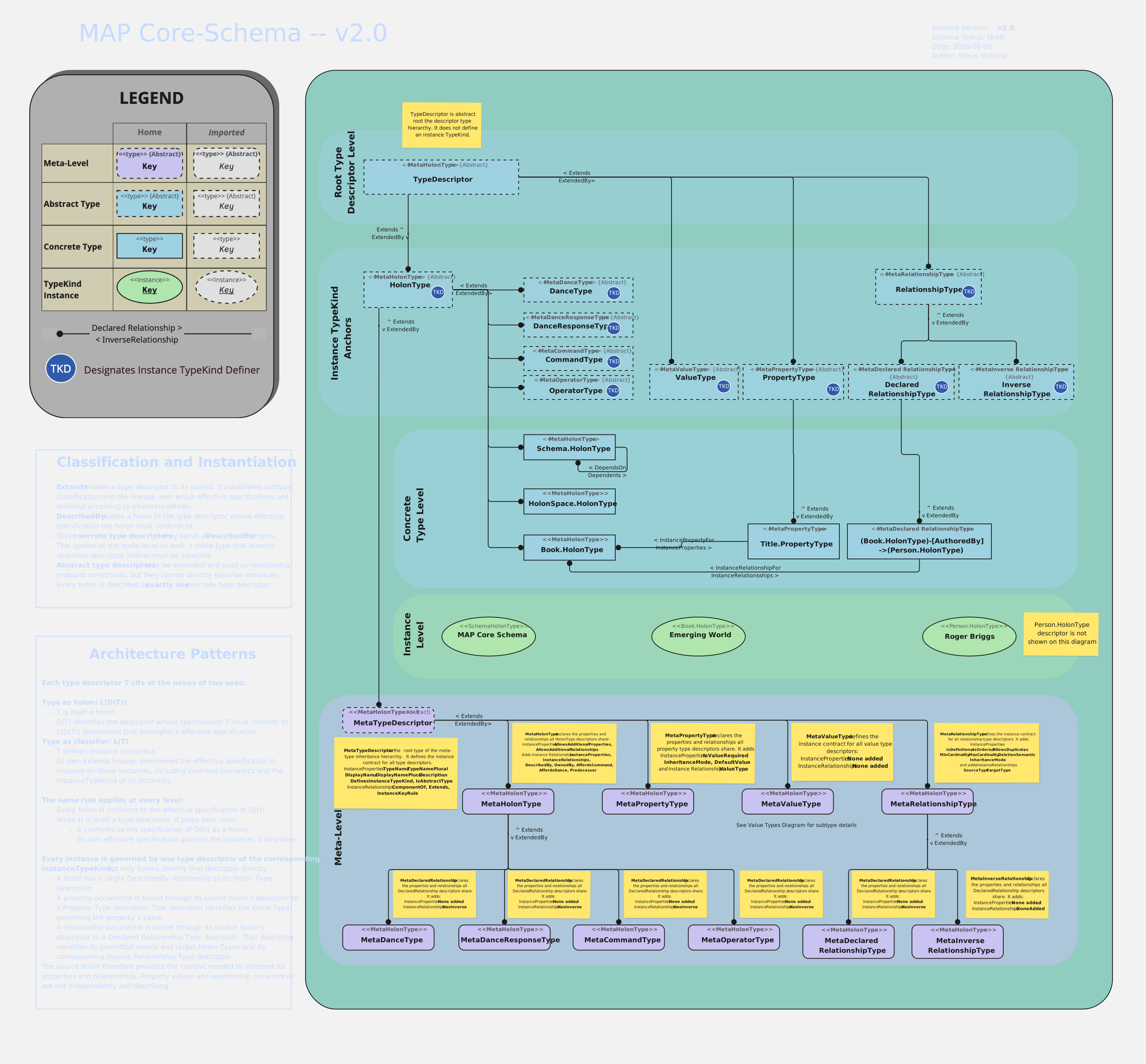
The TDL corpus owns the exact anchor list and declarations.
3.4 Graph-defined meta-type pairing
A descriptor's two axes cannot vary independently. The nearest Instance TypeKind anchor identifies
the expected meta-type category through the anchor's own DescribedBy target. A property
descriptor must therefore be described by the meta-type paired with the Property anchor; a Dance
descriptor must be described by the meta-type paired with the Dance anchor.
This rejects both kinds of mismatch:
MyBook
  DescribedBy MapString.ValueType            # value types do not describe holons

Title.PropertyType
  DescribedBy Book.HolonType                 # descriptor requires a meta-type

Title.PropertyType
  DescribedBy MetaHolonType.MetaTypeDescriptor  # wrong paired meta-type
An extension schema can add a new Instance TypeKind and paired meta-type through authored graph relationships without adding a hard-coded kernel category.
3.5 Self-description is ordinary conformance
Core Schema 2.0 authors MetaHolonType.MetaTypeDescriptor as self-describing. This is not a hidden
bootstrap exemption or a unique-cycle semantic:
MetaHolonType.MetaTypeDescriptor
  DescribedBy MetaHolonType.MetaTypeDescriptor
Any descriptor may be self-describing when it satisfies the same compatibility and conformance
rules as every other descriptor. No semantic rule follows DescribedBy transitively or requires
all describing chains to converge on one reflective root.
Evaluation terminates by computing and memoizing effective products before validating conformance. A self-describing descriptor selects its already computed effective specification; validation does not recursively invoke itself.
3.6 Effective specifications and instance contracts
A type's effective specification is resolved across its own lineage and may include:
- its Instance TypeKind;
- its instance property and relationship contract;
- its effective key rule for holon instances;
- inherited Commands, Dances, and Operators;
- constraints and member definitions; and
- other descriptor members selected by the kernel inheritance table.
The instance contract is the narrower set of effective InstanceProperties and
InstanceRelationships. Contract members are identified by resolved descriptor identity. Their
compact names derive from required local TypeName values and occupy separate property and
relationship namespaces.
Property values and relationship occurrences are not self-describing holons. Their governing descriptors are found through the source holon's effective instance contract.
3.7 Effective member semantics
The relationship-member inheritance table assigns every populated descriptor relationship one of three rules:
Local: only local values contribute;Additive: effective ancestor contributions precede local contributions; orOverride: the first locally populated target set found while walking self-first toward the root wins; an unpopulated local member continues the search and does not implicitly clear inherited values.
Collection policy determines whether the result is a set, multiset, deduplicated sequence, or sequence. Cardinality applies to that final effective collection. Property-member inheritance requires a separate kernel table and is deferred; the relationship table's local fallback does not define property-member behavior. Effective member definitions, including value type, requiredness, defaults, endpoints, cardinality, ordering, duplicates, deletion semantics, and constraints, are resolved across the member descriptor's own lineage.
These algorithms and their validation rule IDs belong to the Descriptor-Kernel Semantic Rules.
3.8 Endpoints use the describing type
An endpoint holon satisfies an endpoint through the lineage of its direct
describing type. An ordinary book can therefore satisfy an endpoint requiring
Book.HolonType. A descriptor holon follows the same rule: a relationship that
targets property-descriptor holons constrains the compatible
MetaPropertyType.MetaTypeDescriptor family, rather than introducing a second
endpoint path through PropertyType.TypeDescriptor.
No alternate EffectiveEndpointType object or descriptor-specific endpoint
branch is needed.
3.9 Abstract descriptors use member-specific completeness
Abstract descriptors classify and contribute semantics but do not directly describe runtime instances. Abstractness is not a blanket conformance exemption. Universally required members remain required; only a member explicitly treated as concrete-only may relax its minimum. Every supplied value is validated normally.
This allows abstract PropertyType.TypeDescriptor to omit a concrete value type without allowing
it to omit structural requirements or populate an invalid value.
3.10 Keys and defaults remain explicit state
Holon types select an effective InstanceKeyRule; explicit NoneRule.KeyRuleType represents
keylessness. Descriptor holons use the key rule selected by their describing meta-type. The retired
TypeKindRule.KeyRuleType is not part of Schema 2.0.
A persisted key is historical explicit state and is not recomputed because a later schema changes a key rule, input, or ancestor.
Defaults are valid only for required properties. A creation workflow that accepts omission as selection of a default materializes the effective value before validation. Explicit values win, optional omissions remain absent, and later default changes do not alter existing holons. The current automatic materialization service is scoped to Holon Loading.
4. Before and After
| Concern | Earlier direction | Schema 2.0 result |
|---|---|---|
| Descriptor conformance | Mixed with specialization | Selected only through D(T) and L(D(T)) |
| Described-instance semantics | Often called a contract in the broad sense | Effective specification, with instance contract as one part |
| Descriptor classification | Declaration form, name, or authored TypeKind could participate |
Descriptor identity and transitive Extends |
| Instance representation kind | Flattened into authored TypeKind |
Nearest explicit DefinesInstanceTypeKind anchor |
| Meta-type selection | Kind-specific rules risked hard-coded tables | Paired through the anchor's own DescribedBy target |
| Contract inheritance | Separate always-additive algorithm | Kernel Additive rule on the two contract relationships |
| Behavior affordance inheritance | Implicit or member-specific behavior | Kernel Additive rule on Command, Dance, and Operator affordance relationships |
| Other semantic inheritance | Set-oriented special cases | Kernel policy table using Local, Additive, or Override |
| Endpoint classification | One synthetic effective endpoint type | TypeSubstitutable(D(H), requiredType) |
| Self-description | Unique reflective-root cycle and convergence | Ordinary compatibility and conformance; no transitive DescribedBy semantic |
| Abstract completeness | Broad exemption or universal-baseline heuristic | Member-specific minimum enforcement |
| Defaults | Read-time fallback or parser-owned insertion | Explicit creation-time materialization outside the kernel |
| Semantic representation | Potential separate semantic IR | Existing holonic representation and HolonDescriptor operations |
4.1 Topology Migration
Earlier schema diagrams placed descriptor categories and their corresponding meta-types in the
same Extends path, for example by making HolonType extend MetaHolonType. Schema 2.0 does not
preserve that topology. Descriptor categories now classify in the unified hierarchy rooted at
TypeDescriptor; concrete meta-types govern descriptor-holon conformance through DescribedBy.
The two diagrams therefore express different models and must not be reconciled as alternate views
of one graph.
Migration also replaces the former UsesKeyRule vocabulary with InstanceKeyRule and authors
directional DeletionSemantic values on both declared and inverse relationship descriptors. Old
diagrams, generated projections, and external schema catalogs must be treated as pre-2.0 until
those relationships and the new topology are reflected explicitly.
5. Corpus and Implementation Consequences
Alignment of the Schema 2.0 TDL source to this model requires:
MetaTypeDescriptor.HolonTypeincludesDefinesInstanceTypeKind.PropertyType;- the property is Boolean, required, defaults to
false, and uses the kernel'sLocalrule; - the intended abstract anchors author local
truevalues; - legacy
TypeKind.PropertyType,TypeKind.MapEnumValueType, andTypeKindRule.KeyRuleTypeare removed; and - declaration forms remain syntactic conveniences and do not infer anchors or category state.
Generated JSON remains downstream of the TDL source. It should be regenerated only through the compiler once the parser accepts the current corpus; it is not hand-edited into semantic authority.
Runtime work must derive any retained TypeKind projection from the resolved anchor identity,
implement the four descriptor-kernel jobs through HolonDescriptor and existing reference-layer
operations, and keep descriptor-aware Holon Validation separate from descriptor-independent PVL.
6. Deliberately Deferred Questions
Schema 2.0 does not settle:
- Extension Schema identity qualification, compatibility, and evolution;
- pairwise inverse deletion execution, cascade termination, and cycle handling;
- a persisted effective-descriptor representation;
- universal use of default materialization outside Holon Loading; or
- migration of persisted Schema 1.2 descriptors and legacy runtime category state.
Those questions may consume this model but must not redefine its classifications or semantic boundaries.
7. Summary
Schema 2.0 reduces the model to two axes over one graph. L(D(T)) determines what a type descriptor
must conform to as a holon; L(T) determines what it imposes on its own instances. Meta-types define
type-definition shape. Explicit Instance TypeKind anchors define the kind of described instances.
Every inherited semantic follows descriptor data, and defaults become explicit before validation.
The concise structural statement belongs in the Schema Design Spec. The exact algorithms and rule IDs belong in the Descriptor-Kernel Semantic Rules. This document preserves why those choices were made.