MAP Commands Specification (v1.3)
ChangeLog
v1.3
- aligns command Dance ingress with Issue 17's canonical name-addressed
DanceInvocationcontract - removes
Dance(DanceRequest)and transitionalDanceResponseretention from the target command surface
v1.2
- aligns Commands with the Query design pivot and Issue 508 contract delta
- removes
TransactionAction::Queryfrom the target command surface - clarifies that navigation/query-like behavior enters Commands as Dance invocation, not as a first-class Query command envelope
- re-centers plural holon-backed command and navigation results on
HolonCollection, with explicit exceptions where the semantics require a narrower result shape - removes
Row,RowSet,BoundHolonCollection, and standalone Query contracts from the command contract target posture - documents retained old-world query traversal artifacts as deprecated compatibility surfaces only
v1.1
- aligns command payload and result posture with the canonical runtime shared type family
- preserves narrower specialized types where they encode real legality or lifecycle constraints
- clarifies that
DanceRequestandQueryExpressionremain transitional bridge payloads - narrows direct
Holonpayload use to infrastructure-level full-state transfer such as cache hydration - adds a command-local appendix for deprecated bridge payloads and envelope-adjacent legacy types
v1.0.0
- established the baseline MAP Commands IPC architecture, scope model, and wire/domain separation
1. Purpose and Design Intent
This specification defines the canonical IPC command architecture for the Memetic Activation Platform (MAP).
MAP Commands define the IPC contract between the TypeScript client (Experience Layer) and the Conductora host runtime (Rust Integration Hub). They provide a strongly typed interface through which the client invokes MAP domain operations inside the IntegrationHub runtime. All stateful execution occurs inside the Integration Hub. The Experience Layer performs no domain mutation and holds no holon state.
For navigation/query-like behavior specifically, Commands should be read as the TypeScript client-to-host ingress adapter for invoking Dances and built-in command actions. Query semantics and execution are not owned by the Commands layer, and the current design does not include a first-class Query command envelope.
MAP Commands are NOT intended to serve as a universal protocol for all MAP communication channels. Other subsystems (such as Trust Channels, host–guest bridges, or storage replay mechanisms) may use different transport formats and adapters.
This specification formalizes the MAP IPC command architecture, including:
- A single structural dispatch boundary
- A split host adapter / runtime execution model
- An explicit scope model
- A strict wire/domain separation ("sandwich model")
- Descriptor-driven execution policy
- Deterministic lifecycle enforcement
MAP Commands Schema-v0.1.0 is separately loadable from
map-holons/schema-src/commands/schema.tdl. It depends on MAP Core
Schema-v0.0.7 and MAP Dance Schema-v0.1.0. Core remains independently
loadable and owns neither Command symbols nor command-affordance occurrences.
Commands owns CommandType, concrete core command descriptors,
AffordsCommand / CommandAffordedBy, command affordance occurrences, and
command payload relationships.
This document is normative for the MAP IPC layer.
2. Architectural Context
This specification defines the MAP Command architecture within the Conductora Tauri container, as shown in the MAP Deployment Architecture.
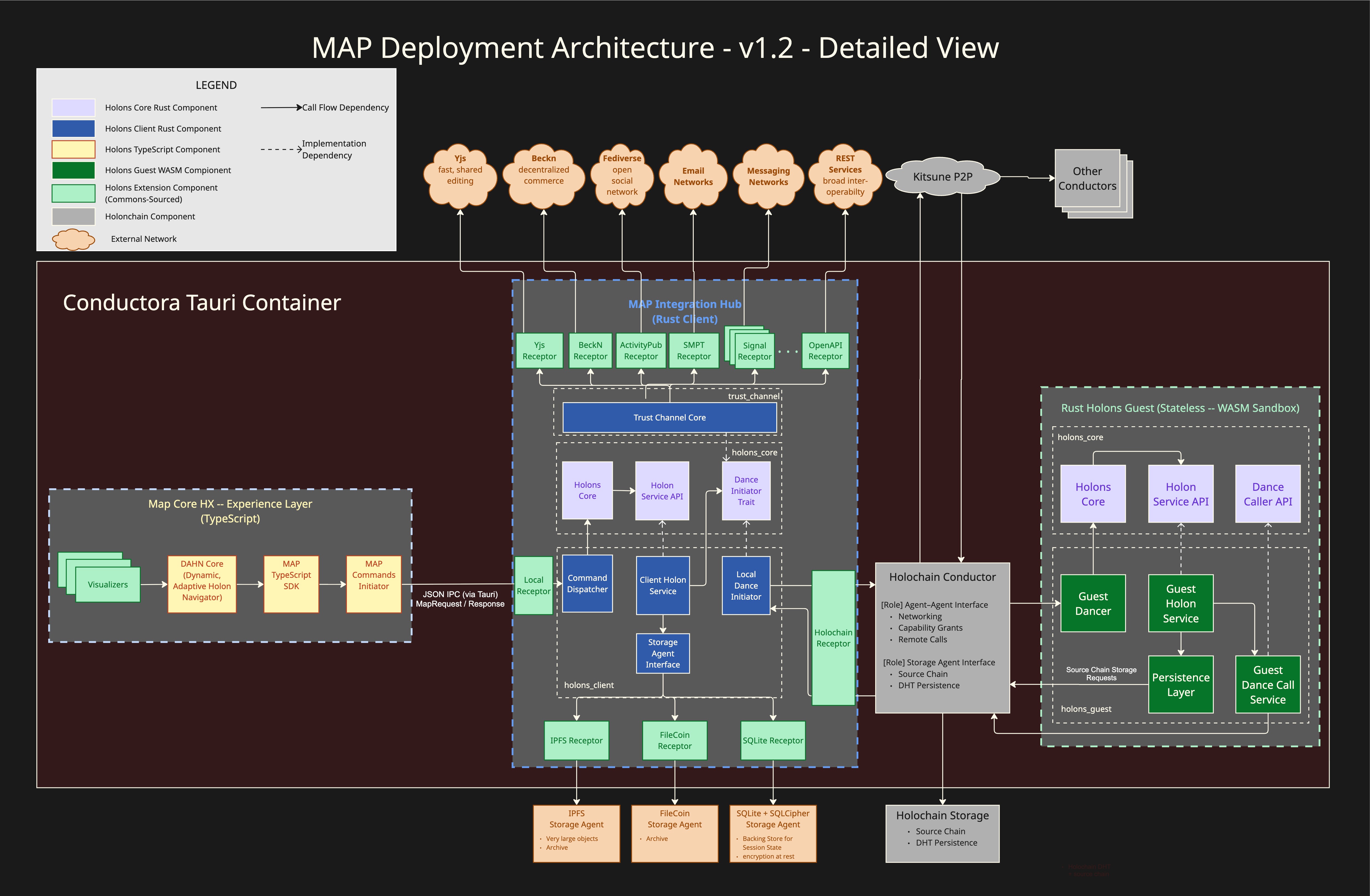
MAP Commands form the structural IPC contract between the TypeScript Experience Layer and the Rust Integration Hub.
They exist exclusively within the Conductora container.
For architectural layering:
- Commands own the TypeScript-facing IPC and dispatch contract
- descriptor-backed navigation behavior lives in Dances afforded by MAP types such as
HolonCollection - future replayable navigation structure lives in
ExecutionPlanholons, not in Commands - old-world query traversal dances may remain reachable as deprecated compatibility through the legacy Dance path only
After the Query design pivot and Issue 508, the intended query/navigation contract posture through this layer is:
- no
TransactionAction::Query - no command-owned
QueryRequest,QueryResult,Row, orRowSetsurface DanceV2(DanceInvocation)as the canonical command path for descriptor-backed DancesHolonReference,HolonCollection, andBaseValueas the retained MAP-native result/value familyReferencesretained only forGetStagedHolonsByBaseKey, where duplicate-base-key staging lookup is a deliberate semantic exceptionNodeCollectiontreated as deprecated compatibility only and not part of the new command seam
This Commands spec is normative for the ingress, wire, and binding layers of that path. It is not the semantic or execution specification for query/navigation behavior itself.
The current implementation is split across three crates with strict dependency direction:
map_commands_contract- owns domain contract types
MapCommand,SpaceCommand,TransactionCommand,HolonCommandMapResultCommandDescriptormap_commands_wire- owns IPC transport and wire types
MapIpcRequest,MapIpcResponseMapCommandWireMapResultWire*Wirevariantsmap_commands_runtime- owns runtime execution
RuntimeRuntimeSession- scope-specific handlers
- lifecycle enforcement
Dependency direction:
map_commands_wiredepends onmap_commands_contractmap_commands_runtimedepends onmap_commands_contractmap_commands_runtimedoes not depend onmap_commands_wire
2.1 IPC Entry Point
All MAP Commands enter the system through a single Tauri IPC function:
dispatch_map_command
Call flow begins:
TypeScript
  → Tauri invoke("dispatch_map_command")
    → dispatch_map_command
    → bind wire → domain
    → Runtime::execute_command
    → domain result → wire result
The Tauri entrypoint is the single IPC ingress.
It:
- Accepts wire types
- Owns IPC envelope handling
- Performs wire-to-domain binding
- Delegates bound commands to Runtime
- Maps domain results back into wire results
- Must not execute domain behavior directly
The Tauri adapter layer is not the domain execution boundary.
For in-band command outcomes, dispatch_map_command returns an envelope-shaped MapIpcResponse and keeps failure detail inside result.Err(HolonError). Outer transport-level failures are reserved for cases where the IPC channel itself cannot produce a response envelope.
dispatch_map_command remains the only IPC entrypoint for MAP command execution.
2.2 Runtime Boundary
Runtime is the single domain execution and policy boundary for bound MAP commands.
It is responsible for:
- Accepting bound domain commands
- Enforcing descriptor policy
- Delegating to scope-specific handlers
- Returning domain results
It is not responsible for:
- owning the IPC envelope
- parsing
MapIpcRequest - constructing
MapIpcResponse - holding
*Wiretypes
No bound command may bypass Runtime.
Navigation/query-specific interpretation:
- Runtime owns the command dispatch seam where a bound Dance action can be handed to dance execution
- descriptor-backed navigation Dances may operate over transaction-visible
HolonReferenceandHolonCollectionvalues - Commands runtime must not become the semantic home of query meaning, planner behavior, navigation algebra, or execution representation
- no first-class bound
Querycommand should be reintroduced unless a later design explicitly proves that Dances and futureExecutionPlanholons cannot satisfy the need
2.3 The Sandwich Model (Wire vs Domain)
MAP Commands strictly separate transport types ("bread") from behavioral domain types ("filling").
Bread (Wire Types)
Wire types exist only:
- In the Tauri entrypoint
- In the host-side MAP command adapter during binding
- When constructing the response
Examples:
MapIpcRequestMapIpcResponseMapCommandWireHolonReferenceWireHolonError
Wire types:
- Are serializable
- Contain identifiers
- Contain no behavioral objects
- Must not cross into domain execution
Filling (Domain Types)
Domain types exist only below the binding seam.
Examples:
MapCommandSpaceCommandTransactionCommandHolonCommandHolonReferenceArc<TransactionContext>HolonError
Domain types:
- Contain behavior
- Contain transaction-bound references
- Must not depend on serialization
- Must not reference any
*Wiretypes
The sandwich is now split across two host-side layers:
- Tauri adapter layer
- owns IPC envelope handling
- performs wire-to-domain binding
- performs domain-to-wire result mapping
- Runtime layer
- owns lifecycle enforcement
- routes bound domain commands to handlers
- executes domain behavior
Wire-to-domain binding occurs exclusively inside the host-side MAP command adapter layer before runtime execution begins.
After binding completes, no *Wire types remain.
For navigation/query-like behavior, this means the contract path should remain structurally separated into:
- TS/client-facing command or SDK helper shape
- wire-safe command ingress shape
- bound host-side Dance command shape
- dance invocation and response shape
- descriptor-backed navigation operation semantics
Those layers may reuse the same runtime shared types where appropriate, but they should not be collapsed into one undifferentiated "query runtime type" or command-owned query envelope.
2.3.1 Runtime Shared Type Posture
MAP Commands retain their own envelopes and scope containers.
Those are not being collapsed.
What is being unified is the inner runtime shared type posture carried by those containers.
The current design direction is:
- prefer the canonical runtime shared type family for general command payloads and results:
HolonReferenceHolonCollectionBaseValue- preserve narrower specialized operand types where they encode real legality or lifecycle constraints:
TransientReferenceforStageNewHolonSmartReferenceforStageNewVersionLocalIdforDeleteHolon- treat full
Holonpayloads as restricted infrastructure-level transfer forms rather than as general command result shapes - do not introduce
Row,RowSet,BoundHolonCollection,QueryRequest,QueryResult, or a standaloneQueryruntime contract as command target shapes - be careful about embedding parameter-significant
HolonReferencevalues in client-originated command payloads, because client-side dereference of those references crosses the IPC boundary back to the host state holder
This means command unification is not “flatten everything into HolonReference or BaseValue.”
It means:
- preserve command semantics
- reduce accidental plural/result shapes
- keep precise specialized reference types where they express real invariants
- converge general plural holon-backed results on
HolonCollection - represent projected records as transient holons with transient or generated descriptors when projection behavior is introduced
- prefer inline value-shaped
Projectionholons, rather than references to projection holons, when Commands need variable parameter shapes whose meaning should be available without follow-on dereference traffic
2.3.2 Client/Host Dereference Heuristic
Commands are specifically the client-to-host ingress path, while the host is the state holder for MAP holons.
That asymmetry changes how HolonReference should be used at the Commands
boundary.
A client-held HolonReference is not merely an in-memory pointer. Dereference
from the client generally becomes another IPC-backed "get" against host-owned
state. Command contracts should therefore avoid using embedded
parameter-significant HolonReference values where the client or adapter would
need to chase those references merely to understand or complete the command.
Normative guidance:
- use
HolonReferencein Commands when identity, targeting, or host-managed object selection is itself the point of the parameter - do not make nested or parameter-object
HolonReferencevalues the default carrier for variable command input shape - when a command needs scalar, mixed-shape, or otherwise variable parameter data, prefer an inline
Projection-shaped holon value rather than a reference to a separate projection holon - if a command result would usually need immediate client-side dereference just to expose its meaningful payload, prefer returning the needed value/projection content directly unless the result is intentionally a persistent or host-managed handle
This heuristic is specific to the Commands ingress layer. It does not overturn the Dances design, where host-side execution may legitimately center invocation and result structure on holons and holon references.
Reference note:
- canonical shared-type definitions live in
docs/core/core-runtime/runtime-shared-types.md - this commands spec owns only the command-surface interpretation and usage of those types
2.4 Host / Guest Demarcation
MAP Commands are a host-side construct.
They execute entirely within the Integration Hub (Rust client layer).
They do not:
- Execute inside the Holochain Conductor
- Execute inside the Rust Holons Guest (WASM)
- Cross into other conductors as command structures
The guest exposes domain capabilities.
The host interprets and dispatches commands.
This separation is fundamental to the sandwich model.
3. Normative IPC Dispatch Definition
The following function is the single normative IPC ingress into MAP domain execution:
type RuntimeState = RwLock<Option<Runtime>>;

#[tauri::command]
async fn dispatch_map_command(
    request: MapIpcRequest,
    runtime_state: State<'_, RuntimeState>,
) -> Result<MapIpcResponse, HolonError> {
    // adapter logic:
    // 1. acquire initialized Runtime
    // 2. bind wire -> domain
    // 3. call Runtime::execute_command
    // 4. map MapResult -> MapResultWire
}
Normative requirements:
- This MUST be the only IPC command that initiates MAP domain execution.
- It MUST accept only wire-layer types.
- It MUST fail if runtime state is not initialized.
- It MUST perform wire-to-domain binding before runtime execution begins.
- It MUST delegate bound commands to runtime execution.
- It MUST convert domain results into wire results.
- It MUST perform no scope inference.
- It MUST perform no domain behavior directly.
All domain execution authority begins inside Runtime::execute_command.
4. IPC Envelope (Wire Layer)
4.1 MapIpcRequest
pub struct MapIpcRequest {
    pub request_id: RequestId,
    pub command: MapCommandWire,
    pub options: RequestOptions,
}

pub struct RequestOptions {
    pub gesture_id: Option<GestureId>,
    pub gesture_label: Option<String>,
    pub snapshot_after: bool,
}
RequestId is currently a MapInteger wrapper, not a plain integer.
4.2 MapIpcResponse
pub struct MapIpcResponse {
    pub request_id: RequestId,
    pub result: Result<MapResultWire, HolonError>,
}
Wire types:
- Are serializable
- Contain identifiers only
- Contain no behavioral objects
- Must not cross below the binding seam
5. Domain Command Surface (Post-Binding)
Command identity is determined exclusively by the structural variant of MapCommandWire.
MAP Commands do not use string-based command routing. Scope and command identity must be derived solely from the structural command variant. These types exist only below the binding seam.
5.1 MapCommand
pub enum MapCommand {
    Space(SpaceCommand),
    Transaction(TransactionCommand),
    Holon(HolonCommand),
}
Scope is explicit and structural.
5.2 SpaceCommand
pub enum SpaceCommand {
    BeginTransaction,
}
5.3 TransactionCommand
pub struct TransactionCommand {
    pub context: Arc<TransactionContext>,
    pub action: TransactionAction,
}
No tx_id strings exist below binding.
5.3.1 TransactionAction
pub enum TransactionAction {
    Commit,
    NewHolon { key: Option<MapString> },
    StageNewHolon { source: TransientReference },
    StageNewFromClone {
        original: HolonReference,
        new_key: MapString,
    },
    StageNewVersion { current_version: SmartReference },
    StageNewVersionFromId { holon_id: HolonId },
    DeleteHolon { local_id: LocalId },
    LoadHolons { bundle: HolonReference },
    DanceV2(DanceInvocation),
    GetAllHolons,
    GetStagedHolonByBaseKey { key: MapString },
    GetStagedHolonsByBaseKey { key: MapString },
    GetStagedHolonByVersionedKey { key: MapString },
    GetTransientHolonByBaseKey { key: MapString },
    GetTransientHolonByVersionedKey { key: MapString },
    StagedCount,
    TransientCount,
}
TransactionAction defines the complete transaction-scoped command surface exposed by the MAP Commands API in v0.
Discrete actions:
-
CommitFinalizes the active transaction. -
NewHolon { key }Creates a new transient holon, optionally with a base key. -
StageNewHolon { source }Stages a new holon from a transient source reference. -
StageNewFromClone { original, new_key }Stages a new holon cloned from an existing holon reference with a new key. -
StageNewVersion { current_version }Stages a new version from an existing smart reference. -
StageNewVersionFromId { holon_id }Stages a new version from an existing holon id. -
DeleteHolon { local_id }Deletes the holon identified by the given local id within the active transaction. -
LoadHolons { bundle }Loads holons from an existing holon reference bundle into the active transaction. -
DanceV2(DanceInvocation)Executes the canonical Dance invocation envelope within the active transaction context.
Current-architecture note:
DanceV2(DanceInvocation)is the only command path for dance invocation- the invocation names its target through canonical
DanceName, which the host resolves to exactly one localDanceTypebefore dispatch - descriptor-backed navigation Dances should enter through this new-world dance invocation path as that surface becomes available
- this does not imply that all ordinary Commands should converge on reference-heavy holonic parameter passing; the client/host dereference heuristic still applies at the command ingress boundary
- after cutover, naming may be simplified again, but during transition the explicit
V2split helps prevent legacy request structures from bleeding into the new-world dance contract
Removed query action:
TransactionAction::Queryis not part of the target Commands API.- Commands do not define a query-specific request/result envelope.
- Navigation behavior should be modeled as descriptor-afforded Dances over
HolonCollection, with future replayable structure represented byExecutionPlanholons. -
QueryExpressionremains only as a deprecated compatibility payload inside retained old-world query dance flows. -
GetAllHolonsReturns all holons visible in the active transaction.
Result posture note:
- plural command results should converge on
HolonCollectionas the canonical holon-backed contract form Referencesis a deliberate exception only forGetStagedHolonsByBaseKey-
projected record sets should be represented as
HolonCollections of transient holons when projection behavior is introduced -
GetStagedHolonByBaseKey { key }Returns the staged holon matching the given base key. -
GetStagedHolonsByBaseKey { key }Returns all staged holons matching the given base key.
Result posture note:
Referencesis the deliberate plural exception for this command because duplicate-base-key staging lookup semantics are not a good fit forHolonCollection-
the command should continue to return
Vec<HolonReference>/MapResult::Referencesuntil a staging-specific plural result shape is needed -
GetStagedHolonByVersionedKey { key }Returns the staged holon matching the given versioned key. -
GetTransientHolonByBaseKey { key }Returns the transient holon matching the given base key. -
GetTransientHolonByVersionedKey { key }Returns the transient holon matching the given versioned key. -
StagedCountReturns the number of staged holons in the active transaction. -
TransientCountReturns the number of transient holons in the active transaction.
5.4 HolonCommand
pub struct HolonCommand {
    pub context: Arc<TransactionContext>,
    pub target: HolonReference,
    pub action: HolonAction,
}

pub enum HolonAction {
    Read(ReadableHolonAction),
    Write(WritableHolonAction),
}
Holon commands carry both:
- a bound transaction context for lifecycle and mutation-policy enforcement
- a bound holon target for holon-local behavior
Dispatch routing does not stop at HolonReference alone; runtime policy evaluation still depends on command context.
5.4.1 HolonAction
pub enum HolonAction {
    Read(ReadableHolonAction),
    Write(WritableHolonAction),
}
HolonAction defines the complete holon-targeted command surface exposed by the MAP Commands API in v0.
Discrete actions:
-
Read(ReadableHolonAction)Executes a non-mutating action against a bound holon reference. -
Write(WritableHolonAction)Executes a mutating action against a bound holon reference.
5.4.1.1 ReadableHolonAction
pub enum ReadableHolonAction {
    CloneHolon,
    Summarize,
    HolonId,
    Predecessor,
    Key,
    VersionedKey,
    PropertyValue { name: PropertyName },
    RelatedHolons { name: RelationshipName },
}
ReadableHolonAction is the definitive list of read-only holon actions exposed through the MAP Commands API.
Discrete actions:
-
CloneHolonClones the target holon and returns a transient reference. -
SummarizeReturns a summary string for the target holon. -
HolonIdReturns the holon id of the target holon. -
PredecessorReturns the predecessor reference of the target holon, if any. -
KeyReturns the base key of the target holon, if any. -
VersionedKeyReturns the versioned key of the target holon. -
PropertyValue { name }Returns the value of the named property on the target holon. -
RelatedHolons { name }Returns the holons related to the target holon by the named relationship as aHolonCollection.
The following ReadableHolon trait methods are explicitly not part of the MAP Commands API surface in v0:
is_accessibleget_all_related_holonsinto_model
These may remain available as internal/runtime APIs without becoming command-level actions.
5.4.1.2 WritableHolonAction
pub enum WritableHolonAction {
    WithPropertyValue { name: PropertyName, value: BaseValue },
    RemovePropertyValue { name: PropertyName },
    AddRelatedHolons { name: RelationshipName, holons: HolonCollection },
    RemoveRelatedHolons { name: RelationshipName, holons: HolonCollection },
    WithDescriptor { descriptor: HolonReference },
}
WritableHolonAction is the definitive list of mutating holon actions exposed through the MAP Commands API.
Discrete actions:
-
WithPropertyValue { name, value }Sets or replaces a property value on the target holon. -
RemovePropertyValue { name }Removes a property value from the target holon. -
AddRelatedHolons { name, holons }Adds one or more related holons under the named relationship. -
RemoveRelatedHolons { name, holons }Removes one or more related holons from the named relationship. -
WithDescriptor { descriptor }Sets the descriptor reference of the target holon.
Operand posture note:
- plural relationship operands should converge on
HolonCollectionat the command contract level - lower-level vector-based forms may remain as implementation helpers during migration, but should not remain the architectural contract center
6. Runtime Structure and Dispatch
pub struct Runtime {
    session: Arc<RuntimeSession>,
}
Responsibilities:
- Accept bound domain commands
- Enforce descriptor policy
- Route to scope-specific handlers
- Execute domain behavior
- Return domain results
6.1 Runtime Boundary Signature
impl Runtime {
    pub async fn execute_command(
        &self,
        command: MapCommand,
    ) -> Result<MapResult, HolonError>;
}
Runtime::execute_command is the normative runtime API.
It accepts already-bound domain commands.
IPC envelope handling and wire conversion occur in the host adapter layer, not in runtime.
6.2 Runtime Session
pub struct RuntimeSession {
    // owns runtime-visible session and transaction state
}
RuntimeSession is the runtime-owned session and transaction layer.
It is responsible for:
- transaction resolution during binding support
- active runtime session state
- access to transaction-scoped execution objects
6.3 Scope-Specific Handlers
impl Runtime {
    fn execute_command_internal(
        &self,
        command: MapCommand,
    ) -> Result<MapResult, HolonError> {
        match command {
            MapCommand::Space(cmd) => self.handle_space(cmd),
            MapCommand::Transaction(cmd) => self.handle_transaction(cmd),
            MapCommand::Holon(cmd) => self.handle_holon(cmd),
        }
    }
}
No *Wire types appear below binding.
Scope branching is structural routing only.
Lifecycle and policy decisions are derived from descriptors.
7. Scope Execution Sequences
7.1 Space Scope
MapIpcRequest(Space)
  → bind in Tauri adapter
  → Runtime::execute_command
  → handle_space
  → MapResult
  → wire response mapping
7.2 Transaction Scope
MapIpcRequest(Transaction)
  → bind in Tauri adapter (tx_id → Arc<TransactionContext>)
  → Runtime::execute_command
  → handle_transaction
  → TransactionContext
  → MapResult
  → wire response mapping
7.3 Holon Scope
MapIpcRequest(Holon)
  → bind in Tauri adapter (HolonReferenceWire + tx context → HolonCommand)
  → Runtime::execute_command
  → handle_holon
  → HolonReference.method()
  → MapResult
  → wire response mapping
8. Descriptor Enforcement Model
pub struct CommandDescriptor {
    pub mutation: MutationClassification,
    pub requires_open_tx: bool,
    pub requires_commit_guard: bool,
}

pub enum MutationClassification {
    ReadOnly,
    Mutating,
    RuntimeDetected,
}
Runtime MUST:
- Resolve descriptor
- Validate lifecycle
- Enforce commit guard if required
Policy derives from descriptor metadata, not command enum branching.
Lifecycle semantics are scope-sensitive:
- Ordinary transaction-scoped read-only commands still require an open transaction.
GetCommittedHolonsis a bounded retained-evidence read: it may inspect Saved members in the transaction's retained Nursery after commit, until explicit disposal. It returns a Collection of identity-only SmartReferences with no staged-property seeding or saved-state fetch. It does not reopen the transaction or permit other transaction lookups/mutations after commit. Loader callers use their dedicated single-submission context and bind the returned identities into a separate review context; see the Load Holons design.- Explicit
Disposelikewise remains available to release retained context state. - Holon-scoped read-only commands do not necessarily require an open transaction, because committed-transaction references remain readable through their retained bound context.
- Mutating commands remain subject to open-transaction and commit-guard requirements as described by their descriptor.
snapshot_after is not currently part of CommandDescriptor.
If snapshot behavior is requested, it is carried in RequestOptions as request metadata at the IPC layer rather than as descriptor metadata in the current implementation.
9. Error Model
Domain error: HolonError
Error conversion occurs only at IPC seams using existing (default) Serialize and Deserialize.
10. Non-Goals
This specification does not:
- Introduce multi-space routing
- Define cross-space execution
- Redesign TrustChannel authority
- Replace transaction lifecycle semantics
- Implement undo/redo
- Define query optimization
- Define a first-class Query runtime contract
- Implement descriptor-backed navigation Dances
- Implement
ExecutionPlanholons or interactive navigation sessions
11. Forward Evolution
Future extensions must preserve:
- Single IPC entrypoint
- Strict wire/domain separation
- Explicit structural scope
- Descriptor-driven policy
- Runtime as the sole domain execution boundary for bound commands
- No wire leakage below binding seam
- No command-owned Query envelope
- Navigation behavior as descriptor-afforded Dances over
HolonCollection - Future replayable navigation structure in
ExecutionPlanholons rather than command variants
Appendix A. Command Bridge-Type Disposition
This appendix records the command-specific subset of the broader runtime shared type disposition posture.
These bridge payloads and adjacent legacy forms may remain in code during migration and test preservation, but they are not part of the target new-world command contract design.
| Type | Classification | New-world status | Allowed use in the new world | Notes |
|---|---|---|---|---|
DanceRequest |
Superseded bridge | Remove | None | Remove with callers and tests; no compatibility path is required |
DanceInvocation carried by DanceV2 |
Canonical surface-owned envelope usage | Keep | Canonical dance invocation path through Commands | The invocation carries required canonical DanceName and holon references, not a direct Dance descriptor reference |
QueryExpression |
Deprecated compatibility payload | Deprecate | Legacy old-world query dance compatibility only | Retained only inside old-world DanceRequest / query-method dance flows; must not reappear as TransactionAction::Query or a substrate-facing command query contract |
Node, NodeCollection, QueryPathMap, DanceType::QueryMethod(NodeCollection) |
Deprecated compatibility payload family | Deprecate | Legacy query_relationships and fetch_all_related_holons compatibility only |
Retained for legacy compatibility only; not part of the new command seam or preferred new-world result posture |
HolonCollection |
Canonical runtime shared type | Keep | General-purpose plural holon-backed command, dance, and navigation result carrier | Primary plural runtime carrier; projected record sets should become HolonCollections of transient holons |
BoundHolonCollection |
Deferred candidate / removed target posture | Defer | None in the current command target contract | Do not introduce unless a future lifecycle or contract need cannot be represented by HolonCollection plus surrounding plan/session/result structure |
Row |
Removed query/command contract artifact | Remove | None in the current command target contract | Projected records should be transient holons with transient or generated descriptors, not row-shaped command contracts |
RowSet |
Removed query/command contract artifact | Remove | None in the current command target contract | Projected record sets should be HolonCollections, not a row-stream or table-shaped command result carrier |
QueryRequest, QueryResult, QueryResultData, QueryDiagnostic |
Removed standalone Query contracts | Remove | None | Commands do not own a first-class query request/result contract |
Vec<HolonReference> as a command contract operand |
Implementation helper | Keep internally only | Low-level internal collection handling | Vector-based collection forms may remain internally but should not remain the command contract center |
direct full Holon payloads in general command contracts |
Restricted infrastructure pattern | Restrict | Infrastructure-level full-state transfer only | Legitimate for narrow cache-hydration or internal retrieval paths, not as the general command result posture |